Showing posts with label Music. Show all posts

Sunday, January 12, 2014

"This Takes the Cake"


At some point you've most likely said or heard someone say "this takes the cake" or "it's a cakewalk".  Ever wonder what those phrases mean?

The surprising history from NPR…
The cakewalk was a pre-Civil War dance originally performed by slaves on plantation grounds. The uniquely American dance was first known as the "prize walk"; the prize was an elaborately decorated cake. Hence, "prize walk" is the original source for the phrases "takes the cake" and "cakewalk." 
Here's how the dance worked: Couples would stand in a square formation with men on the inside perimeter and then dance around the ballroom "as if in mimicry of the white man's attitudes and manners," according to Richard Kislan. The steps included "a high-leg prance with a backward tilt of the head, shoulders and upper torso." 
Plantation owners served as judges for these contests — and the slave owners might not have fully caught on that their slaves might just have been mocking them during these highly elaborate dances.

Monday, December 23, 2013

Six Drummers

We were introduced to some amazingly creative percussion by our Swedish family who are our houseguests for Christmas. Tack.

Wednesday, August 7, 2013

R.I.P. George Duke


Funky, jazzy, prolific...a musician's musician.

Back in the day, I'd play Dukey Stick over and over and over again. Unfortunately, the best part of the song -- the part about Sheila E getting dropped off -- was left out in the video above.

From the NYT...
“I was in a rock band, I played with a bunch of Brazilians, I played R&B with Parliament-Funkadelic and all of that,” he said in an interview before his most recent album, “DreamWeaver,” was released last month. “I mean, I’ve done jazz with Miles Davis and Cannonball Adderley. It’s a goulash. It’s a gumbo.” 
Mr. Duke, who as a small boy begged his mother to buy him a piano after she took him to see Duke Ellington, began playing professionally at a time when many musicians were interested in blending genres. He played in a trio that backed the singer Al Jarreau while he was still a teenager, then accompanied Dizzy Gillespie and other jazz musicians at clubs in San Francisco. By the early 1970s he had performed and recorded with Adderley, the jazz violinist Jean-Luc Ponty and Zappa’s Mothers of Invention.

Saturday, August 3, 2013

Ryan Wang


Maybe it's not too late to learn to play.

From the CBC...
CBC Music asked 5 year old Piano Prodigy to perform some of his repertoire for Dorothy Landry.

Dorothy is 101 years old and perhaps Ryan's biggest fan. Even though she has seen him perform before she is hard of hearing so never fully got to experience Ryan playing. She gets a front row seat for this performance.

Saturday, July 6, 2013

From Nirvana to the Special Forces


What a trip.

From the NYT...
He had three drill sergeants, two of whom were sadists. Thank God it was the easygoing one who saw it. He was reading a magazine, when he slowly looked up and stared at Everman. Then the sergeant walked over, pointing to a page in the magazine. “Is this you?” It was a photo of the biggest band in the world, Nirvana. Kurt Cobain had just killed himself, and this was a story about his suicide. Next to Cobain was the band’s onetime second guitarist. A guy with long, strawberry blond curls. “Is this you?”
Everman exhaled. “Yes, Drill Sergeant.”
And that was only half of it. Jason Everman has the unique distinction of being the guy who was kicked out of Nirvana and Soundgarden, two rock bands that would sell roughly 100 million records combined. At 26, he wasn’t just Pete Best, the guy the Beatles left behind. He was Pete Best twice.
Then again, he wasn’t remotely. What Everman did afterward put him far outside the category of rock’n’roll footnote. He became an elite member of the U.S. Army Special Forces, one of those bearded guys riding around on horseback in Afghanistan fighting the Taliban.

Saturday, March 16, 2013

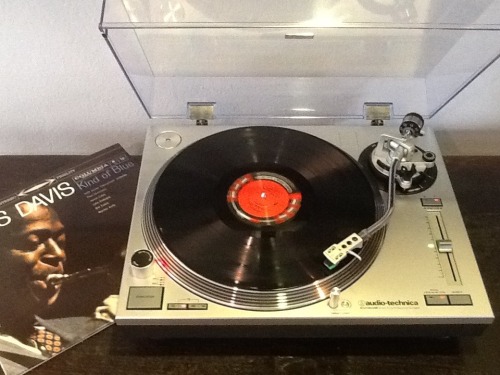
My New Toy...


...which was a must in order to listen to a few hundred 78s, most of which have never been played before.

And six -- or eight depending on how you count -- new albums to add to the stash thanks to one of the best record stores in the U.S.:
Kind of Blue, Miles
A double Billie Holiday
A double Charlier Parker
Exodus, Bob
U2 and B.B.
Under the Blood Red Sky, U2
It's been a very musical weekend so far.

Thursday, March 7, 2013

The "A" Train


After taking this photo earlier today, I just couldn't resist.

From Wiki...
"Take the 'A' Train" was composed in 1939, after Ellington offered Strayhorn a job in his organization and gave him money to travel from Pittsburgh to New York City. Ellington wrote directions for Strayhorn to get to his house by subway, directions that began, "Take the A Train". Strayhorn was a great fan of Fletcher Henderson's arrangements. "One day, I was thinking about his style, the way he wrote for trumpets, trombones and saxophones, and I thought I would try something like that," Strayhorn recalled. 
The use of the Strayhorn composition as the signature tune was made necessary by a ruling in 1940 by the American Society of Composers and Publishers (ASCAP). When ASCAP raised its licensing fees for broadcast use, many ASCAP members, including Ellington, could no longer play their compositions over radio, as most music was played live on radio in those days. Ellington turned to Billy Strayhorn and son Mercer Ellington, who were registered with ASCAP competitor BMI to "write a whole new book for the band," Mercer recalled." 'A' Train" was one of many songs written by Strayhorn, and was picked to replace "Sepia Panorama" as the band's signature song. Mercer recalled that he found the song in a trash can after Strayhorn discarded a draft of it because it sounded too much like a Fletcher Henderson arrangement. The song was first recorded on January 15, 1941 as a standard transcription for radio broadcast.

Saturday, March 2, 2013

Riding the Trane

Despite the extensive vinyl jazz collection my father built up shockingly there isn't a single John Coltrane album.

This past week, I fixed that oversight and added five very nice pieces of vinyl to the treasure trove.


Sunday, February 3, 2013

One Hit Wonders


Last Tuesday, I was sitting in my seat waiting for the plane to depart for a hop across the pond to London.  Across the aisle from me was a gentleman, decked out in red leather pants, red sweater, red tennis shoes, and decent amount of gold accessories.

Shortly after take-off, I overheard him say to a couple sitting next to him and his wife, "That song has been very good to me. It won me a Grammy." I was already curious but after that comment I was very curious.

What song? Who is this guy?

My chance to find out came when we landed and his wife asked me to get her bag down from the overheard. I said to her, "I heard your husband say that he's a musician." She replied. "He's a singer. His name is Billy Paul." At which point, I feigned knowledge "Ohh!, ok."

Her: "You've heard of him?"
Me: "Oh, yes." (translation: Nope, I have no idea who he is.)
Me: "Well, have a good trip"

Out comes my Blackberry (yes, I'm stuck with one of those), I did a Google, and quickly learned which song has been very good to Mr. Paul.

What I don't know is if she was Mrs. Jones.

Sunday, January 13, 2013

Whole Lotta Helter Skelter

This is what happens when you toss The Beatles and Led Zeppelin into a blender...


Pretty good.

Thursday, December 27, 2012

The Time of Music

1899 - a musician is born in Washington, DC
1916 - a music lover is born in Washington, DC
1930's - their paths cross after a performance and lead to a backstage poker game
1950's - an album is recorded and purchased by the music lover
1950's - the music lover opens a record store and expands his album collection
1960's - the son of the music lover is born
1970's - a receiver is manufactured
1980's - a turntable is manufactured
2001 - the music lover dies
2011 - a set of speakers is built
2012 - 113 years later it all comes together

Because of each step above, I now have the pleasure of listening to this gem...


...and much more.

I'm forever grateful for my Dad's gift of music to me.

Take the "A" Train. Yeah!

Friday, November 16, 2012

Mashup Time


Brilliantly simple.

Via The Daily Dish...
This is incredible: Miles Davis and LCD SoundSystem mashed up, by simply playing two YouTube videos simultaneously without any other manipulation.

Saturday, October 13, 2012

"We Shall Overcome"


The history behind the Civil Rights Movement's iconic song.

From Blank on Blank...
The question today: just how does a popular song become more than just hit? How does it come to define an era and carve out a prominent place in American history? Well, our contributor Josh Baron got an answer when he spoke with folk music legend Pete Seeger. They talked over the phone and Seeger was still going strong past 90 years old. 
Back in 1963, Pete Seeger recorded the song “We Shall Overcome.” He played it during a famous concert at Carnegie Hall. This just weeks before the March on Washington. And the song proved to be a huge hit for Seeger. But Seeger says this anthem of the civil rights movement has many fathers and mothers, brothers and sisters.

Saturday, September 29, 2012

Robert Nesta Marley

Last night we finally watched the recently released documentary about Robert Nesta Marley.

If you're a fan of Bob Marley's music, the documentary, although a little long, is a must see.  Bob's life encompassed so much more than his music. It's a beautiful story.

The full documentary is currently available on YouTube...

Saturday, September 15, 2012

Strange Fruit's Strange Story


You're probably familiar with Billie Holiday's iconic song "Strange Fruit", if not you should be.


This post isn't about the song, for that go here here.  Instead it's about the songwriter, Abel Meeropol, and his connection to W.E.B. Du Bois and the Rosenbergs (yes, those Rosenbergs). 

From NPR...
In the late 1930s, Pellison says, Meeropol "was very disturbed at the continuation of racism in America, and seeing a photograph of a lynching sort of put him over the edge." Meeropol once said the photograph "haunted" him "for days." 
So he wrote a poem about it, which was then printed in a teachers union publication. An amateur composer, Meeropol also set his words to music. He played it for a New York club owner — who ultimately gave it to Billie Holiday.
Fast forward to 1945...
"Abel Meeropol's pen name 'Lewis Allan' were the names of their children who were stillborn, who never lived," says his son, Robert Meeropol. He and his older brother, Michael, were raised by Abel and his wife, Anne Meeropol, after the boys' parents — Ethel and Julius Rosenberg — were executed for espionage in 1953. 
Julius and Ethel Rosenberg were sentenced to death for conspiring to give atomic secrets to the Soviet Union. The Rosenbergs had also been Communists. At the time, the Rosenberg sons, Robert and Michael, were 6 and 10, respectively. 
Robert Meeropol says that in the months following his parents' execution, it was unclear who would take care of him and his brother. It was the height of McCarthyism. Even family members were fearful of being in any way associated with the Rosenbergs or Communism. Then, at a Christmas party at the home of W.E.B. Du Bois, the boys were introduced to Abel and Anne Meeropol. A few weeks later, they were living with them.
The audio story...

Saturday, September 8, 2012

Gangnam Style


With 126 million views on YouTube and counting (about 3 of those are mine), the latest K-Pop song to make a splash and the first to hit it big in the U.S. may contain some rather subversive messages about South Korean society.

From The Atlantic...
Gangnam is a tony Seoul neighborhood, and Park's "Gangnam Style" video lampoons its self-importance and ostentatious wealth, with Psy playing a clownish caricature of a Gangnam man. That alone makes it practically operatic compared to most K-Pop. But I spoke with two regular observers of Korean culture to find out what I was missing, and it turns out that the video is rich with subtle references that, along with the song itself, suggest a subtext with a surprisingly subversive message about class and wealth in contemporary South Korean society...

..."Koreans have been kind of caught up in this spending to look wealthy, and Gangnam has really been the leading edge of that," Hong said. "I think a lot of what [Psy] is pointing out is how silly that is. The whole video is about him thinking he's a hotshot but then realizing he's just, you know, at a children's playground, or thinking he's playing polo or something and realizes he's on a merry-go-round."

Wednesday, July 4, 2012

Happy 4th!

It's not one of my favorite holidays but I do like this version of the Star Spangled Banner. 


Wednesday, June 27, 2012

Milk Chocolate City


Interesting op-ed about my hometown. I agree with the ultimate conclusion.

From the NYT...
This is the rage, long simmering just beneath the surface, that is bubbling over now that Washington, the once-majority-black city immortalized in George Clinton’s 1975 funk classic “Chocolate City,” has lost its black majority. But even before the data corroborated that demographic milestone last year, Washington’s makeover had created something of an identity crisis. 
Ever since Washington was carved from two slaveholding states in 1791, it has been a special place for black Americans. Lincoln freed the slaves in Washington about nine months before the Emancipation Proclamation, prompting blacks from the region to flock here. It was the birthplace of Duke Ellington and home to other artists like Zora Neale Hurston and Sterling Allen Brown, who later fueled the Harlem Renaissance. By 1957, blacks had become the majority of the city’s residents, exceeding numbers in any major city in the United States. Ever since Walter E. Washington was appointed mayor by Lyndon B. Johnson in 1967, the city has been led by black politicians and shaped by black institutions. This has fostered a sense of black privilege, swagger and, yes, the hubris that comes with leadership. 
My own initiation in the ways of Chocolate City came nearly 20 years ago when, after growing up black in nearly all-white environments, I arrived in Washington as a freshman at historically black Howard University. The Washington I encountered then was a strange, alternate universe: I saw black schools taught by black teachers and run by black principals reporting to black superintendents. Black restaurants. Black hospitals run by black doctors and staff members. Black suburbs. Black judges ordering black police officers to deliver black suspects to black jail wardens. And of course a black-owned music industry, go-go.  In Washington, we were not “minorities,” with the whiff of inferiority that label carries; we were “normal.” For the first time in my life, I felt at home. 
Some days, walking the streets of Washington, a seemingly colder place where people don’t always exchange greetings, I feel nostalgic for the days of black privilege that George Clinton crooned about. But given the warmth of many of my new neighbors of many races, I would like to see the transformation around me as racial progress. The change in attitudes that caused a generation of whites to release their fears and return to the urban centers their parents fled a generation ago is the same change in attitudes that allowed millions of white Americans, in the quiet sanctity of the voting booth, to vote for a black man named Barack Hussein Obama.

LinkWithin

Related Posts