Showing posts with label Studies. Show all posts

Sunday, January 12, 2014

A Fish in Every Pot


Brilliant thinking outside the pot. 

From The Atlantic...
In 2008, Christopher Charles was living in Cambodia and researching anemia. The condition, which is commonly caused by iron deficiency, afflicts roughly half of Cambodia’s children and pregnant women. Untreated, it can lead to lethargy, impaired growth and cognitive development in children, and increased risks of premature delivery and maternal mortality. 
Charles, a Canadian epidemiologist, knew that iron-rich foods and supplements were too expensive for most rural Cambodians. Even cast-iron pots, which safely transmit iron to food as it cooks, were out of reach. But he wondered whether a small piece of iron placed in a standard aluminum pot would have a similar iron-releasing effect. To test his hypothesis, Charles distributed blocks of iron to local women, telling them to place the blocks in their cooking pots before making soup or boiling drinking water. The women promptly put them to use as doorstops. 
After talking with village elders, Charles learned of a fish known as try kantrop, which the locals ate frequently and considered a symbol of good luck. When he handed out smiling iron replicas of this fish, women started cooking with them. “People associated it with luck, health, and happiness,” he says. Within 12 months, Charles reports, anemia in villages where the fish was distributed virtually disappeared.

Sunday, December 1, 2013

For Sports Fans

Turn on a game and get a (tiny) workout.

From HuffPo...
Watching sport can make you fitter, according to research Sunday that said viewing other people exercise increases heart rate and other physiological measures as if you were working out yourself. 
The study, published in the international journal Frontiers in Autonomic Neuroscience, showed that when watching a first person video of someone else running, heart rate, respiration, skin blood flow and sweat release all increased.
BUT…
While the study concluded that your body will get a small workout from simply watching others exercise, Macefield cautioned that nothing compared to real physical activity. 
"While watching other people exercise may increase your heart rate and have other physiological effects, nothing can replace the health benefits of getting off the couch," he said.

Sunday, June 23, 2013

Falling Behind


For those who think the minimum wage is too high, think again.

From HuffPo...
The federal minimum wage of $7.25 is worth $2 less today than it was in 1968 when adjusted for inflation. That's one of the findings in a June study by the non-partisan Economic Policy Institute. 
Today, the minimum wage, which hasn't increased since 2009, falls short of a living wage. According to the EPI study, a full-time worker would need to earn $11.06 an hour in 2011 to keep a family of four out of poverty. 
In February, President Barack Obama proposed raising the the federal minimum wage to $9 an hour. Republican lawmakers unanimously voted down a House proposal to raise the minimum wage in March.

Thursday, May 30, 2013

You Are What You Eat

Not extremely surprising but the linkage is still fascinating.

From SciTechDaily...
UCLA researchers now have the first evidence that bacteria ingested in food can affect brain function in humans. In an early proof-of-concept study of healthy women, they found that women who regularly consumed beneficial bacteria known as probiotics through yogurt showed altered brain function, both while in a resting state and in response to an emotion-recognition task. 
“Many of us have a container of yogurt in our refrigerator that we may eat for enjoyment, for calcium or because we think it might help our health in other ways,” said Dr. Kirsten Tillisch, lead author of the study. “Our findings indicate that some of the contents of yogurt may actually change the way our brain responds to the environment. When we consider the implications of this work, the old sayings ‘you are what you eat’ and ‘gut feelings’ take on new meaning.” 
Researchers have known that the brain sends signals to the gut, which is why stress and other emotions can contribute to gastrointestinal symptoms. This study shows what has been suspected but until now had been proved only in animal studies: that signals travel the opposite way as well.

Tuesday, May 21, 2013

The Election Wasn't Fair

Republicans are correct, the election wasn't fair.

From Political Wire...
A new Hamilton College poll finds that heading into the 2012 election, "both Democrats and Republicans expressed concerns about the fairness of the election. Only 15% of Republicans and 19% of Democrats were very confident that the election would be decided fairly." 
"After the election, fears about voter fraud abated among Democrats but skyrocketed among Republicans, with 58% of Republicans not confident at all about the fairness of the election."
But just not in the way they think.

From the Washington Post...
Faller, Nathan, and White “contacted every local official or election commission responsible for overseeing elections for each county or municipality at which elections are administered in 48 states.” One quarter of the e-mails used a Latino-sounding name, like “Luis Rodriguez,” and asked the voter ID question you see above. Another quarter used a non-Latino-sounding name, like “Greg Walsh”. The other half asked a control question using both sets of names to see if asking about voter ID in particular had any effects. 
[Of] 6,825 sent e-mails to officials in 46 states, [a]t least 4,557 officials replied. But the interesting story is in who they did and didn’t reply to. “Responses to Latino names,” the researchers write, “are three-and-a-half to four percentage points less likely than to non-Latino white names.” The bias against Latino e-mailers was about three points greater in voter ID questions. 
The finding holds up when you drop certain regions, when you drop small towns, and when you control for whether officials are elected or appointed. What’s more, they find that there are actually statistically significant differences in the quality of response from officials, depending on what kind of name is used. Responses to Latino voters were likelier to be non-informative, less likely to be “absolutely accurate”, and even less likely to take a friendly tone.
Institutional racism at work.

Tuesday, March 26, 2013

Dazed and Confused


A sedated nation. The '74 Valium percentage is stunning.

From Wellcome History...

1950s America: those were the good old days. Or were they? Viewing the past through rose-coloured spectacles – longing with a special kind of nostalgia for the white picket fences, home-baked cookies and families with a Mom, Dad and 2.5 children – makes misleading history. When contemporary critics bemoan today’s immoral society with its broken families and workaholic mothers, it is this era that they often hark back to. But postwar America was far from idyllic. Gazing historically inside the average suburban American house uncovers families still suffering from the economic fallout of the Depression, and a culture alarmed by the shadow of a constant threat of nuclear war and communism. The ‘domestic goddess’ cooking the family’s meal had a dark secret too. Everyday drug use for depression was very common among American mothers. 
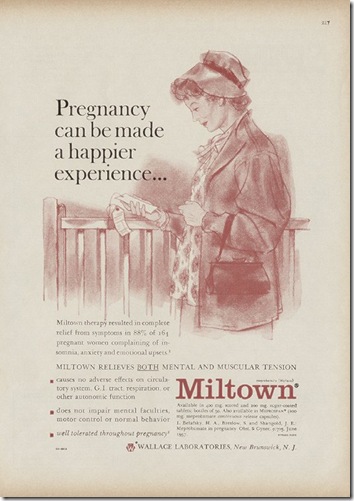
In 1955, the first tranquilliser, Miltown, burst onto the American drug market. It was the first medicine to be marketed to the public in a manner similar to other popular consumer products, and was soon in huge demand. Within a year, a staggering 1 in 20 Americans were regularly prescribed it. Pharmacies frequently ran out of stocks, having to hang window signs declaring “Out Of Miltown – More Tomorrow!”

The drug was a potent and prescription-only tranquilliser, most often used by [suburban housewives]...Such anecdotes spawned a flurry of Miltown cocktail recipes for star-struck housewives to copy. There was the ‘Militini’, a martini with a pill replacing the olive. Or those more daring drinkers could try a ‘Guided Missile’ – a double vodka and two Miltowns. Cartier advertised a silver charm bracelet with a convenient holder designed for a single Miltown pill. This was a medicine like no other – until it was surpassed by its descendant, Valium. By 1974, an astonishing total of 53.4 million Americans were taking Valium – a quarter of the whole population.

The Value of an Education


It's a lot higher than one may think.

From Evan Soltas via The Dish...
The high school dropout rate among people whose fathers were dropouts is 22.2 percent. The dropout rate with high-school-grad fathers is 2.9 percent. Let's assume that the social value of a high school degree is $30,000 per graduate; that's roughly the difference in average income between non-grads and grads. Public policy that supposes they are helping one person assesses the value of that degree at $30,000, obviously. Public policy that supposes they are helping an infinite succession of people assesses the value of that degree at $819,000.

Monday, December 24, 2012

Fiendishly Clever


So the solution to mass killings is guns in schools and bullet proof backpacks?

From The Washington Post...
At least half a dozen companies sell bulletproof backpacks and vests for children, and since the country’s second-worst school shooting, they say business has greatly increased. In Arizona, a body armor manufacturer called Amendment II says sales of its bulletproof children’s backpacks — Avengers for boys, Disney princesses for girls — have risen more than 500 percent. Black Dragon Tactical, a survivalist company in New Hampshire, is promoting armored backpack inserts on its Facebook page. 
“Arm the teachers, in the meantime, bulletproof the kids,” Black Dragon said on its Facebook page Sunday. “These panels fit into most common backpacks.”
But wait...
Studies have shown that highly visible efforts to increase school safety, such as cameras and armed guards, decrease students’ feelings of security, said Eric Rossen, a clinical psychologist and administrator at the National Association of School Psychologists. That’s another risk with bulletproof backpacks, he said. Children who don’t feel safe also don’t feel connected or understood, ultimately undermining their ability to learn and to form trusting relationships, he said.
"Don't feel connected or understood."
"Undermining their ability to learn and form trusting relationships."

Isn't that what they say are traits of mass murderers?

Ahhh, I get it now, these folks want to create a continuous loop.

Thursday, December 13, 2012

Time Flies When You're Having Fun

Devilishly brilliant.

From NPR...
We're in Milan. We're not happy. We're waiting for a bus that doesn't seem to come. Then we see this:
Three different sized sheets of bubble wrap, sized for how long you expect to wait: a little square for three minutes, bigger for five minutes, biggest for 10 — and the sign on top says: "Antistress For Free!!"

Saturday, November 24, 2012

Black Friday


The comparison to the bubonic plague hits the nail on the head. 

From Marketplace...
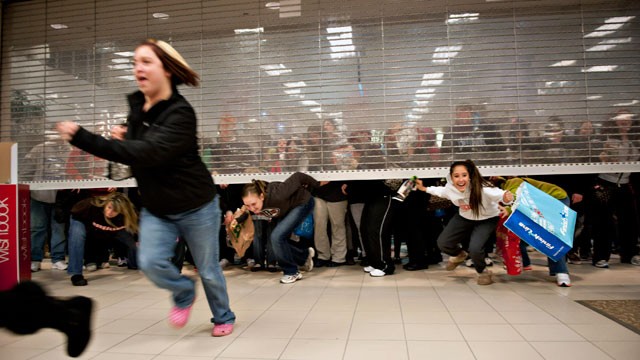
The term itself has an interesting history. In the 1950s, some factory managers referred to the day after Thanksgiving as "black Friday" because so many workers called in sick. The day, noted one industrial magazine, was "a disease second only to the bubonic plague" in its effects on employees. In the early 1960s, Philadelphia cops used the term to describe the intense crowds of shoppers and traffic that poured into center city on the day after Thanksgiving. It was hardly a term of endearment. All the people and congestion made police work more difficult. As a sales manager at Gimbels said, watching a cop trying to deal with a group of jaywalkers, "the police think in terms of headaches that it gives them." 
Still, the term stuck. And by the mid 1970s, newspapers in and around Philadelphia used it to refer to the start of holiday shopping.
And as reported by the Washington Post, the whole thing is pretty much a scam.
From an economists’ perspective, this is a case in which the retailers are using a rationing mechanism other than price to allocate scarce goods: They price a limited number of TVs and other products at a below-market price, and then ration those goods based on who is willing to stand in line the longest. Essentially, the buyers receiving the discounts are “paying” the store by standing in line for hours upon end, creating the sense of anticipation that in turn attracts the TV cameras and, the retailers hope, eventually a broader group of consumers who will pay the actual market price.
But it's a useful measure of the strength of the economy, right?

Wrong.
In fact, sales over Thanksgiving weekend tell us virtually nothing about retail sales for the full holiday season—let alone anything meaningful about the economy as a whole. Paul Dales of Capital Economics analyzed the relationship between retail sales during the week of Thanksgiving against the overall change in retail sales for November through January. As the chart shows, the relationship is a very weak one, with dots all over the grid. But if there is any conclusion to draw at all, the relationship is actually negative!

Monday, October 29, 2012

Herders vs. Farmers


An interesting theory about the origins of the Red-Blue state divide.

From the NYT...
The historian David Hackett Fischer traces the divide back to the British settlers of colonial America. The North was largely settled by English farmers, the inland South by Scots-Irish herders. Anthropologists have long noted that societies that herd livestock in rugged terrain tend to develop a “culture of honor.” Since their wealth has feet and can be stolen in an eye blink, they are forced to deter rustlers by cultivating a hair-trigger for violent retaliation against any trespass or insult that probes their resolve. Farmers can afford to be less belligerent because it is harder to steal their land out from under them, particularly in territories within the reach of law enforcement. 
As the settlers moved westward, they took their respective cultures with them. The psychologist Richard Nisbett has shown that Southerners today continue to manifest a culture of honor which legitimizes violent retaliation. It can be seen in their laws (like capital punishment and a stand-your-ground right to self-defense), in their customs (like paddling children in schools and volunteering for military service), even in their physiological reactions to trivial insults.
It doesn't quite explain California.

Sunday, October 28, 2012

NaCl


America: leading the salty way.

From Good...
The study, published in the Canadian Medical Association Journal, examined the salty offerings of six fast food chains—Burger King, Domino’s, KFC, McDonald's, Pizza Hut, and Subway—in six countries—Australia, Canada, France, New Zealand, the United Kingdom, and the United States. The U.S. fast food industry consistently delivered more salt per gram than the (still very salty!) fast-food average. America has got the saltiest pizzas in the world. The salt levels in our "savory breakfast items" are comparatively ridiculous. McDonald's Chicken McNuggets sold in the United States contain two and a half times more salt than do British McNuggets.

This is a problem for American lifespans—according to the study, a moderate reduction in our collective salt intake could save more American lives than similar public health efforts to cut smoking. But the processed food industry has been slow to come on board with salt reduction efforts, claiming that cutting salt from its foods is just too technically difficult to pull off.
"Too difficult to pull off". WTF? (I'll skip the whole putting a man on the moon reference.)

Saturday, September 15, 2012

Made in China

We seem to have a tendency to think a lot of the "stuff" we buy is made in China. 

And we are wrong.

How much is actually made in China? About 3%.

From Think Progress... 
A very interesting analysis by Galina Hale and Bart Hobijn of the San Francisco Fed concludes that very little of American personal consumption spending actually ends up in China. When Americans go buy stuff, they’re overwhelmingly buying things that are made in America.  
In part, this reflects the fact that 67 percent of spending is on services rather than goods, and services are 96 percent made in the USA. But even durable goods, which only account for about 10 percent of total spending, are mostly made in America — 66.6 percent to 12 percent for China with the rest coming from the rest of the world. In fact the only category of spending in which Made in the USA doesn’t account for the majority is clothing and shoes.

Monday, September 3, 2012

Family Trees


An interesting article that reminds me of the vast number of people in Asia who claim to be descendents of Genghis Khan.  Looks like it's probably true.

From the BBC...
How far do we have to go back to find the most recent common ancestor of all humans alive today? Again, estimates are remarkably short. Even taking account of distant isolation and local inbreeding, the quoted figures are 100 or so generations in the past: a mere 3,000 years ago.

And one can, of course, project this model into the future, too. The maths tells us that in 3,000 years someone alive today will be the common ancestor of all humanity.

Monday, July 23, 2012

US: 12,000 vs. Japan: 11


This is a comparison in which the U.S. will always prevail.  I'll go with the Japanese any day.

From The Atlantic...
Friday's horrific shooting at an Aurora, Colorado, movie theater has been a reminder that America's gun control laws are the loosest in the developed world and its rate of gun-related homicide is the highest. Of the world's 23 "rich" countries, the U.S. gun-related murder rate is almost 20 times that of the other 22. With almost one privately owned firearm per person, America's ownership rate is the highest in the world; tribal-conflict-torn Yemen is ranked second, with a rate about half of America's.  
But what about the country at the other end of the spectrum? What is the role of guns in Japan, the developed world's least firearm-filled nation and perhaps its strictest controller? In 2008, the U.S. had over12 thousand firearm-related homicides. All of Japan experienced only 11, fewer than were killed at the Aurora shooting alone. And that was a big year: 2006 saw an astounding two, and when that number jumped to 22 in 2007, it became a national scandal. By comparison, also in 2008, 587 Americans were killed just by guns that had discharged accidentally.  
Almost no one in Japan owns a gun. Most kinds are illegal, with onerous restrictions on buying and maintaining the few that are allowed. Even the country's infamous, mafia-like Yakuza tend to forgo guns; the few exceptions tend to become big national news stories.
So what does cheese have to do with this? Well, in the U.S. it's easier to buy a semi-automatic weapon than a wedge of raw milk cheese which is easily available in almost all of the rest of the world.  The impact?

From AmericaBlog...
"Two people died over fifteen years from eating raw milk cheese," Aravosis writes. "Significantly more died over that period from guns, about 450,000 people."
Go figure.

Saturday, June 30, 2012

Who's Better for the Economy?


The data speaks for itself.

From the Daily Dish...
In a new book, Richard J. Carroll [an economist at the World Bank] lays out an analysis of presidential economic performance since Truman. The results are unambiguous:

Five out of six Democrats reduced the national debt as a percentage of GDP, while four out of six Republicans raised it. The story is similar on budget deficits, with five of the top six performances recorded by Democrats and four of the bottom five recorded by Republicans. With respect to GDP growth, three of the top four performers were Democrats and four of the bottom five were Republicans. In reducing the poverty rate, the top three were Democrats and two of the bottom three were Republicans. The Democrats also had a better record on employment. Republicans had better records on reducing inflation, achieving four of the top five performances, while Democrats had four of the bottom five showings. Republicans also did well in lowering tax revenue as a percentage of GDP, claiming the top five spots.
How does Obama fare?

When all of the indicators are combined, [Obama] ranks ninth out of 12, one position below Reagan but above Bush 41, Carter and Bush 43.

Thursday, June 14, 2012

Sleep On It


Take a nap or at least a break.

From The New Yorker...
The researchers gave a group of students a tedious task that involved transforming a long list of number strings into a new set of number strings. The task was designed so that there was an elegant shortcut, but it could only be uncovered if the subject had an insight about the problem. When people were left to their own devices, less than twenty per cent of them found the shortcut, even when given several hours to mull over the task. The act of dreaming, however, changed everything: after people were allowed to lapse into R.E.M. sleep, nearly sixty per cent of them discovered the secret pattern.

If this all sounds like scientific justification for afternoon naps, long showers, and Russian literature, you’re right. “We always assume that you get more done when you’re consciously paying attention to a problem,” Schooler told me. “That’s what it means, after all, to be ‘working on something.’ But this is often a mistake. If you’re trying to solve a complex problem, then you need to give yourself a real break, to let the mind incubate the problem all by itself. We shouldn’t be so afraid to actually take some time off.”

Sunday, April 29, 2012

A Sweet Problem


The MMR vaccine isn't the culprit. Could it be high fructose corn syrup?

A fascinating article and related study from Grist...
In a provocative new peer-reviewed study published in Clinical Epigenetics, researchers led by a former FDA toxicologist purport to have found a very real link between HFCS consumption and autism. 
The study’s argument is complicated but deeply disturbing. It pieces together what’s known about the genetic and metabolic factors involved with autism, including the growing evidence of a link between autism and mercury and organophosphate pesticide exposure.
Essentially, HFCS can interfere with the body’s uptake of certain dietary minerals — namely zinc. And that, when combined with other mineral deficiencies common among Americans, can cause susceptible individuals to develop autism.

Friday, April 27, 2012

Blacks on Ice


I really could care less about hockey but I do care about racism and sadly this doesn't surprise me at all.

From the WaPo...
When Joel Ward scored the overtime winner for the Capitals to end the defending Stanley Cup champion Boston Bruins’ season, a wave of racist tweets surfaced (warning: it's very vile stuff). They ranged from casually offensive to viciously hateful. None were shocking. But they illustrated the latent sentiment that exists in many pockets of the fan base that hockey is a sport to be played and enjoyed by whites.

Being a black hockey fan can be a singular experience. You can feel the racial divide at games. So when Ward lit the lamp last night, yes, personally, it felt good to see a black man score such an important goal for the franchise.

It's about time that the NHL tackled its race issues head-on. If the league wants to move forward as a brand, they need to recognize that they can do something about racism.
Coincidentally, I also heard this story on NPR yesterday.  The two kind of go hand-in-hand.

From NPR...
Hockey teams wearing darker-colored jerseys are more likely to be penalized for aggressive fouls than teams wearing white jerseys, according to new research. Teams wearing black jerseys in particular get penalized the most, according to an analysis that may offer a window into the hidden psychological dynamics of the ongoing NHL playoffs. 
"Teams that wore black jerseys were penalized more, significantly more, than teams wearing other colored jerseys," said researcher Gregory Webster of the University of Florida, Gainesville...

...A third possibility, Webster said, is that players were not doing anything different, but that the referees had unconscious biases against black and other dark colors. 
"There is this very strong cultural association that comes through in how we think about colors in terms of white being associated with good and black with bad," Webster said. "Many of us are raised from childhood with some of these associations. And over time, we develop a kind of cognitive bias. That's been shown time and time again in social psychology."

Sunday, April 22, 2012

Performance vs. Mastery


An interesting comparison that makes perfect sense.

From Barking Up the Wrong Tree...
“People with performance goals are more deceitful” and less likely to share information with coworkers, both in the laboratory and in real-world offices he has studied, Poortvliet says. “The reason is fairly obvious—when you want to outperform others, it doesn’t make sense to be honest about information.”

On the other hand, people who are trying to improve themselves are quite open, he says. “If the ultimate goal is to improve yourself, one way to do it is to be very cooperative with other people.” This can help improve the work environment, even though the people with these goals aren’t necessarily thinking about social relations. “They’re not really altruists, per se. They see the social exchange as a means toward the ends of self improvement.”

LinkWithin

Related Posts