Showing posts with label Science. Show all posts
Showing posts with label Science. Show all posts
Wednesday, February 19, 2014
The Jump Revisited
Baumgartner's stratosphere jump was both crazy and awesome 18 months ago. Check out the recently released GoPro footage of his dive, it looks even crazier and more awesome now.


Tuesday, February 18, 2014
Storing Memories
The video doesn't look like much but it's pretty fracking amazing.
From I Fucking Love Science...
Scientists have known for a while that our memories are the process are synaptic transmissions in our brain and are stored in neurons, but they have been able to film the actual process for the first time inside of a mouse.
Memories are made by messenger RNA (mRNA) that encode β-actin protein. These proteins are responsible for shaping and structuring cells in the neurons. As events unfold, β-actin protein is responsible for reshaping the neurons and creating a path, retracing the synaptic steps. Memory retention is delicate business, and it is possible for even a single molecule to determine whether or not the memory is stored. Any disruptions in the process can result in a lost memory.
Because the process is so delicate, it has been incredibly difficult for researchers to see it happen in real time. First, they tagged the mRNA which codes for β-actin protein with green fluorescent protein. The researchers then stimulated the hippocampus, which is a small region of the brain that has most of the ability to form and store memories. Following stimulation, the researchers were actually able to witness the synthesis of the β-actin-encoding mRNA in the nucleus of the neuron. The molecules were then tracked out to the dendrites, where communication between neurons takes place.
Saturday, December 21, 2013
The Chemistry of Cookies
As you make Christmas cookies keep this video in mind.
From YouTube…
From YouTube…
I had no idea so much was going on in a cookie.
A commenter at Gizmodo nails the "real chemistry" though…
The real chemistry of baking cookies comes only when you are real young.....and its a cold chilly fall/winter day .....you just helped your mother or grandmother mix up a big batch of chocolate chip or oatmeal raisin.....you got to lick the spoon and maybe a little bit of the bowl....she opens the oven door and the kitchen is filled with a warmth that chases the cold from the room...and the fresh baked smell fills the air that teases you with the notion that the best is yet to come......Ahhhhh, I remember that experience like it was yesterday. Enjoy the holidays!
Thursday, November 21, 2013
Mars Flyover
A stunning view of our galactic next door neighbor.
From I Fucking Love Science…
The ‘flyover’ comes courtesy of Mars Express which was launched by the European Space Agency on 2 June 2003 and arrived at Mars six and a half months later. The spacecraft has orbited the Red Planet nearly 12,500 times since its arrival and has beamed back data and images collected by the scientific instruments aboard.
This data was collated to create a nearly global digital topographic model of Mars’ surface, making the viewing of the ‘flyover’ a three dimensional experience. The flyover explores the grabens, valleys, canyons, mountains and lava flows in unprecedented detail.
Monday, September 2, 2013
Echoes
For this post, I was planning to focus on the impressive skills of this guy...
But a commenter to the video mentioned of a boy named Ben Underwood. I looked him up and have one word to describe his talents, amazing.
Sadly, Ben passed away in 2009 at the age of 16 after the cancer that took his eyesight re-emerged.
Thursday, August 1, 2013
The Kopp-Etchells Effect


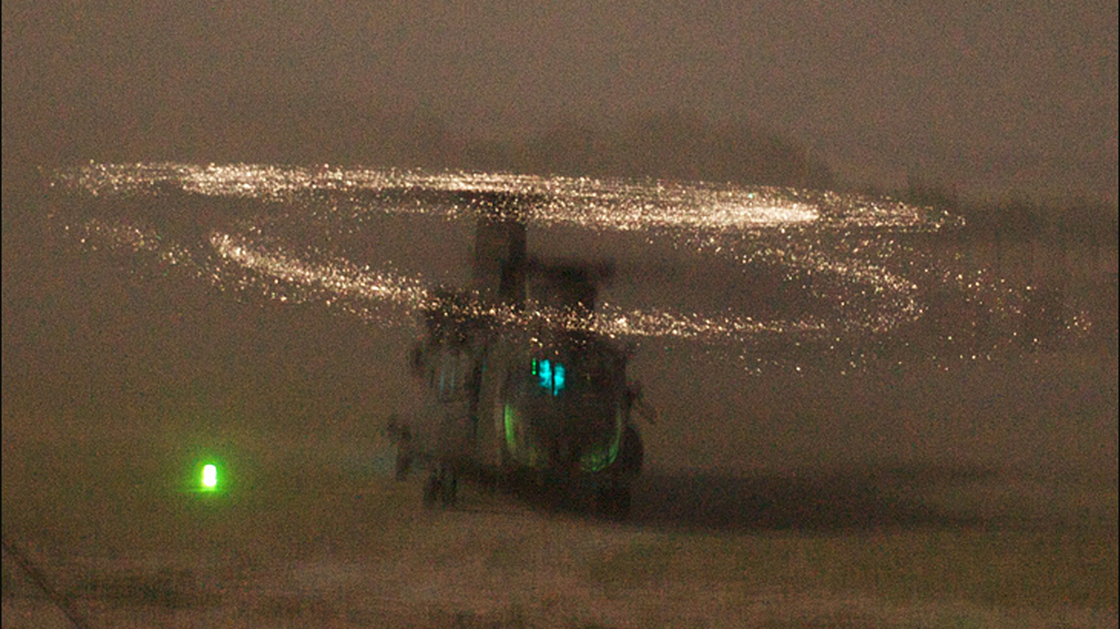
A photographer's unique tribute to two soldiers.
From Robert Krulwich at NPR...
This isn't a painting. It's not from a movie. It's not a strange astronomical event. This is real — what you can see when certain helicopters in Afghanistan touch down on sandy ground, raising dust, causing mysterious arcs of light to loop and dance through the air.
This doesn't always happen. "The halos usually disappear as the rotors change pitch," wrote war photographer Michael Yon. "On some nights, on this very same landing zone, no halos form." How come?
Michael thought whatever causes this, it ought to have a name. And because he could, because most of these are his pictures, he decided to dub these lights "The Kopp-Etchells Effect." Curiously, (and to me, very happily), the name is beginning to catch on. [S]o who, I wondered, are Kopp and Etchells? Are they physicists?
They aren't. Or weren't. They are, both of them, soldiers...The rest of the story is here.
Tuesday, July 30, 2013
Getting a Boost
A video from the point of view of the Space Shuttle solid rocket booster. The beginning is standard fare for folks who've watched Space Shuttle videos over the years but it starts to get kind of trippy about a quarter of the way in.
Saturday, July 27, 2013
Inception in Our Future?

This sounds crazy and to some probably dangerous. Whatever your take on it I find it fascinating.
From the Washington Post...
“Now that we can reactivate a memory, can we tinker with that memory, maybe making it into a false memory?” Ramirez asked.
Putting a new mouse in the red chamber, they let it recognize the room as harmless. The following day, they had it explore a blue-walled chamber, and then gave it a mild jolt while simultaneously inducing recall of the red room. This was meant to artificially associate the memory of the shock-free red room with the fear of being shocked.
On the third day, Tonegawa and his colleagues wanted to see whether this false association had successfully been implanted. They placed the mouse in the red room, where it froze even though nothing bad had ever happened to it there. A false memory had been formed and recalled.
Although implanting a memory won’t happen anytime soon in people, in principle, it should be possible to isolate a human memory and activate it at will, scientists said.
Monday, July 22, 2013
You Are Here

On July 19, NASA's Cassini spacecraft captured the color images of Earth and the moon from its perch in the Saturn system nearly 900 million miles away.
In the images Earth and the moon appear as mere dots -- Earth a pale blue and the moon a stark white, visible between Saturn's rings. It was the first time Cassini's highest-resolution camera captured Earth and its moon as two distinct objects.
It also marked the first time people on Earth had advance notice their planet's portrait was being taken from interplanetary distances. NASA invited the public to celebrate by finding Saturn in their part of the sky, waving at the ringed planet and sharing pictures over the Internet. More than 20,000 people around the world participated.
Pictures of Earth from the outer solar system are rare because from that distance, Earth appears very close to our sun. A camera's sensitive detectors can be damaged by looking directly at the sun. Cassini was able to take this image because the sun had temporarily moved behind Saturn from the spacecraft's point of view and most of the light was blocked.
Thursday, May 30, 2013
The Woolly Mammoth Cometh...

...maybe.
A perfectly preserved woolly mammoth carcass with liquid blood has been found on a remote Arctic island, fueling hopes of cloning the Ice Age animal, Russian scientists said Thursday.
The carcass was in such good shape because its lower part was stuck in pure ice, said Semyon Grigoryev, the head of the Mammoth Museum. “The blood is very dark, it was found in ice cavities bellow the belly and when we broke these cavities with a poll pick, the blood came running out,” he said in statement.
Wooly mammoths are thought to have died out around 10,000 years ago. Scientists have deciphered much of the woolly mammoth’s genetic code from their hair, and some believe it’s possible to clone them if living cells are found. Grigoryev said the find could provide the necessary material.
Friday, May 24, 2013
Spooky Action Over Time

Whenever I read about quantum mechanics I feel like I have an IQ of about 1. Nonetheless, even though I don't understand 90% of it reading about various aspects of "spooky action at a distance" is a great mindblower.
Physicists have long known that quantum mechanics allows for a subtle connection between quantum particles called entanglement, in which measuring one particle can instantly set the otherwise uncertain condition, or “state,” of another particle—even if it’s light years away. Now, experimenters in Israel have shown that they can entangle two photons that don’t even exist at the same time.
[A lot of stuff in between that I don't understand...]
So what’s the advance good for? Physicists hope to create quantum networks in which protocols like entanglement swapping are used to create quantum links among distant users and transmit uncrackable (but slower than light) secret communications. The new result suggests that when sharing entangled pairs of photons on such a network, a user wouldn’t have to wait to see what happens to the photons sent down the line before manipulating the ones kept behind, Eisenberg says. Zeilinger says the result might have other unexpected uses: “This sort of thing opens up people’s minds and suddenly somebody has an idea to use it in quantum computing or something.”
Tuesday, May 21, 2013
Bee All You Can Bee

Producing honey and pollinating our fruits and veggies didn't quite cut it.
From Wired...
A team of Croatian researchers are training honeybees to sniff out unexploded mines that still pepper the Balkans.
Croatia, Bosnia-Hercegovina and other countries from former Yugoslavia still have around 250,000 buried mines which were left there during the wars of the early 90s. Since the end of the war more than 300 people have been killed in Croatia alone by the explosives, including 66 de-miners.
Tracking down the mines can be extremely costly and dangerous. However, by training bees -- which are able to detect odours from 4.5 kilometres away -- to associate the smell of TNT with sugar can create an affective way of identifying the locations of mines. Bees have the advantage of being extremely small and so don't run the risk of setting off the explosives in the same way that trained mammals such as dogs or rats do.
Saturday, March 30, 2013
Tuesday, March 26, 2013
Dazed and Confused
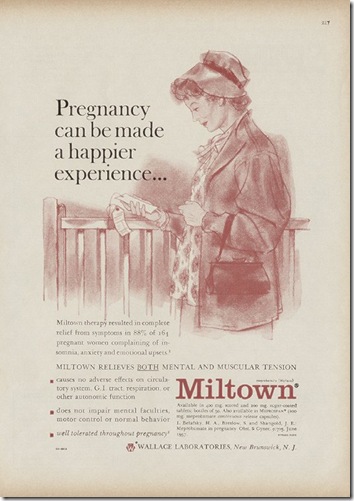

A sedated nation. The '74 Valium percentage is stunning.
From Wellcome History...
1950s America: those were the good old days. Or were they? Viewing the past through rose-coloured spectacles – longing with a special kind of nostalgia for the white picket fences, home-baked cookies and families with a Mom, Dad and 2.5 children – makes misleading history. When contemporary critics bemoan today’s immoral society with its broken families and workaholic mothers, it is this era that they often hark back to. But postwar America was far from idyllic. Gazing historically inside the average suburban American house uncovers families still suffering from the economic fallout of the Depression, and a culture alarmed by the shadow of a constant threat of nuclear war and communism. The ‘domestic goddess’ cooking the family’s meal had a dark secret too. Everyday drug use for depression was very common among American mothers.
In 1955, the first tranquilliser, Miltown, burst onto the American drug market. It was the first medicine to be marketed to the public in a manner similar to other popular consumer products, and was soon in huge demand. Within a year, a staggering 1 in 20 Americans were regularly prescribed it. Pharmacies frequently ran out of stocks, having to hang window signs declaring “Out Of Miltown – More Tomorrow!”
The drug was a potent and prescription-only tranquilliser, most often used by [suburban housewives]...Such anecdotes spawned a flurry of Miltown cocktail recipes for star-struck housewives to copy. There was the ‘Militini’, a martini with a pill replacing the olive. Or those more daring drinkers could try a ‘Guided Missile’ – a double vodka and two Miltowns. Cartier advertised a silver charm bracelet with a convenient holder designed for a single Miltown pill. This was a medicine like no other – until it was surpassed by its descendant, Valium. By 1974, an astonishing total of 53.4 million Americans were taking Valium – a quarter of the whole population.
Thursday, February 28, 2013
More on 3D Printing
I'm a believer.
From an innovation and economic standpoint, 3D printing will do for the next two decades what the internet did for the past two. Buckle up and enjoy the ride, it's going to be a wild one.
Wednesday, February 13, 2013
Driverless Cars
The shape of things to come and probably sooner than we think.
From Grist...
- When cars are much lighter, it will be easier to move them using electricity. And when you switch out an internal combustion engine for simple electric motors on each wheel, you save another huge chunk of weight, further increasing electric range.
- Once most cars are electric, the top cause of urban air pollution would be eliminated. Urban air quality — and thus urban public health — will increase exponentially. There will be fewer work and school days lost to illness.
- If there’s a fleet of shared driverless vehicles available, and a car can drive itself to you whenever you need one, there will be no need to owna car. Why lug it around? Now, think about the last time you drove around in an American suburb. Imagine if all those houses didn’t need garages. What could all the extra space be used for? Think about all the gasoline and insurance and maintenance money involved in car ownership replaced by a simple, cheap subscription fee to a car service. What would all the saved money be used for?
- Today the average American spends about 100 hours a year commuting (I have a hard time believing that 100 hours number), and there is nothing more soul-crushing than driving in traffic. Imagine having all those hours back. The car is driving, so you’re reading, sending email, calling clients, surfing the internet. You’re working. What would it mean to you to have 100 more hours a year? What would it mean to U.S. economic productivity to have billions of additional work hours every year? What would be the net health and psychological effects of all that reduced stress?
Saturday, February 2, 2013
Darwin's Birthday
Today marks the 204th birthday of Charles Darwin.
What's so special about his 204th birthday? Nothing, I just like the graphic.
Tuesday, January 29, 2013
DNA Drives

Get ready for your hard drive to be replaced by DNA.
From Discover...
Scientists announced yesterday that they successfully converted 739 kilobytes of hard drive data in genetic code and then retrieved the content with 100 percent accuracy.
The researchers began with the computer files from some notable cultural highlights: an audio recording of MLK Jr.’s 1963 “I Have a Dream” speech, all 154 of Shakespeare’s sonnets, and, appropriately, a copy of Watson and Crick’s original research paper describing DNA’s double helix structure. On a hard drive, these files are stored as a series of zeros and ones. The researchers worked out a system to translate the binary code into one with four characters instead: A, C, G and T. They used this genetic code to synthesize actual strands of DNA with the content embedded in its very structure.
So what does DNA offer that other data storage methods don’t? One, it can pack data really densely. A single gram of DNA holds more than a million CDs, according to the researchers. Two, DNA lasts a really long time in a range of conditions. It is not nearly as sensitive or fragile as existing data centers. Three, DNA has a reputation for safely storing information: It holds the history of all life on Earth, a tough resumé to top.
The thing holding the technology back at this point is the cost. Sequencing and especially synthesizing the DNA is a pricey process, but like most new technologies, it is getting cheaper fast. The researchers say DNA data storage could be a large-scale solution as soon as 2023.
Saturday, January 12, 2013
Sorry, No Death Star

The White House responds to a "We the People" petition to "secure resources and funding, and begin construction of a Death Star by 2016."
Classic.
From The White House...
The Administration shares your desire for job creation and a strong national defense, but a Death Star isn't on the horizon. Here are a few reasons:
- The construction of the Death Star has been estimated to cost more than $850,000,000,000,000,000. We're working hard to reduce the deficit, not expand it.
- The Administration does not support blowing up planets.
- Why would we spend countless taxpayer dollars on a Death Star with a fundamental flaw that can be exploited by a one-man starship?
The entire reply is worth a read.
Thursday, January 3, 2013
Subscribe to:
Posts (Atom)
LinkWithin
