Showing posts with label Drugs. Show all posts

Tuesday, March 26, 2013

Dazed and Confused


A sedated nation. The '74 Valium percentage is stunning.

From Wellcome History...

1950s America: those were the good old days. Or were they? Viewing the past through rose-coloured spectacles – longing with a special kind of nostalgia for the white picket fences, home-baked cookies and families with a Mom, Dad and 2.5 children – makes misleading history. When contemporary critics bemoan today’s immoral society with its broken families and workaholic mothers, it is this era that they often hark back to. But postwar America was far from idyllic. Gazing historically inside the average suburban American house uncovers families still suffering from the economic fallout of the Depression, and a culture alarmed by the shadow of a constant threat of nuclear war and communism. The ‘domestic goddess’ cooking the family’s meal had a dark secret too. Everyday drug use for depression was very common among American mothers. 
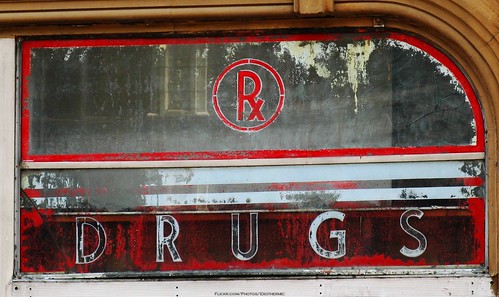
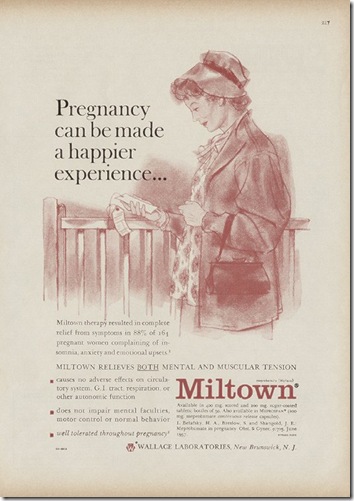
In 1955, the first tranquilliser, Miltown, burst onto the American drug market. It was the first medicine to be marketed to the public in a manner similar to other popular consumer products, and was soon in huge demand. Within a year, a staggering 1 in 20 Americans were regularly prescribed it. Pharmacies frequently ran out of stocks, having to hang window signs declaring “Out Of Miltown – More Tomorrow!”

The drug was a potent and prescription-only tranquilliser, most often used by [suburban housewives]...Such anecdotes spawned a flurry of Miltown cocktail recipes for star-struck housewives to copy. There was the ‘Militini’, a martini with a pill replacing the olive. Or those more daring drinkers could try a ‘Guided Missile’ – a double vodka and two Miltowns. Cartier advertised a silver charm bracelet with a convenient holder designed for a single Miltown pill. This was a medicine like no other – until it was surpassed by its descendant, Valium. By 1974, an astonishing total of 53.4 million Americans were taking Valium – a quarter of the whole population.

Wednesday, January 30, 2013

Monsignor Meth

Is the Catholic Church now a creative consultant to Breaking Bad?

This one is completely bizarre.

From The Daily Beast...

Sex toys, ruby red slippers, drug paraphernalia, and a Roman collar!
Those all were to be elements of The Land of Oz & Dorothy’s Place, a combination adult novelty shop that Monsignor Kevin Wallin apparently planned to take over and move to a new location after he was suspended from his Bridgeport, Conn., parish amid reports of him cross-dressing and having sex in the rectory.

Add methamphetamine to the list, according to the government, which alleges that the 61-year-old cleric now dubbed “Monsignor Meth” used the store to launder proceeds from a transcontinental drug enterprise... 
...“While in Wallin's residence, the UC [undercover police officer] observed Wallin open a desk drawer inside which was contained small Ziploc baggies, spoons, and scales,” the affidavit states. “The UC also observed a large, gallon size Ziploc bag filled with what appeared to be crystal methamphetamine.”

The UC further observed that Wallin had a safe inside a closest. The affidavit says Wallin provided the UC with the numbers of two cellphones he would call if “he wished to purchase crystal methamphetamine in the future.” Wallin did not seem to be a neophyte in the ways of narcotics peddling.

Tuesday, August 7, 2012

Drugs


So the most addictive and most harmful drugs are legal but a person can be tossed in the slammer, families broken apart, assets seized, and voting right revoked for possession of less addictive and less harmful substances.  Makes perfect sense.

From Barking up the Wrong Tree...

What percentage of users become addicted?
  • 4% of people who drink alcohol.
  • 8% of people who use marijuana.
  • 22% of people who smoke or inject cocaine.
  • 35% of people who inject heroin.
  • 80% of people who try cigarettes.

What is the most harmful drug?
Overall, MCDA modelling showed alcohol was the most harmful drug (overall harm score 72), with heroin (55) and crack (54) in second and third places. The other drugs assessed followed in this order in terms of overall harm: Crystal meth (33), cocaine (27), tobacco (26), amphetamine/speed (23), cannabis (20), GHB (18), benzodiazepines (eg valium) (15), ketamine (also 15), methadone (14), mephedrone (13), butane (10), khat (9), ecstacy (9), anabolic steroids (9), LSD (7), buprenorphine (6), mushrooms (5).

Sunday, May 27, 2012

He's Got a Point

A bit of a rant but I completely agree with Penn's point...


I'm hopeful that the former Choom Gang member will do the right thing in term deux.

Tuesday, March 13, 2012

MJ OD?


According to the DOJ and the DEA, it's virtually impossible.

From The Daily Dish...
A Department of Justice/DEA brief from 1988 reads:

[A] marijuana smoker would have to consume 20,000 to 40,000 times as much marijuana as is contained in one marijuana cigarette. ... A smoker would theoretically have to consume nearly 1,500 pounds of marijuana within about fifteen minutes to induce a lethal response.
So exactly why is the Obama administration continuing the war on medical marijuana?

Saturday, March 10, 2012

Coke and Coke...Still


Who knew.

From Good.Is...
In fact, the United States (and most other nations) expressly prohibits the sale and trade of coca leaves. In order for Coca-Cola to continue to exist in its current form, the company has a special arrangement with the Drug Enforcement Administration, allowing it to import dried coca leaves from Peru (and to a lesser degree, from Bolivia) in huge quantities. The dried coca leaves make their way to a processing plant in Maywood, New Jersey, operated by the Stepan Corporation, a publicly traded chemicals company. The Stepan factory imports roughly 100 metric tons of the leaves each year, stripping the active ingredient—the cocaine—from them. The cocaine-free leaves are then shipped off to Coke to turn into syrup, and, ultimately, soda. 
What does Stepan do with the cocaine? It goes to the Mallinckrodt Corporation, which creates a legal, topical anesthesia called cocaine hydrochloride. Cocaine hydrochloride is used to numb the lining of the mouth, nose, or throat, and requires a DEA order form to obtain.

Friday, March 2, 2012

Drugs and Trees


Damn meth heads!

From Grist...
This is the Senator, the largest pond cypress in the U.S. and, at 3,500 years old, the fifth-oldest individual tree in the world. Or anyway, this was the Senator, because on Jan. 16, the Florida tree burned from the inside out. 
Authorities initially ruled out arson, saying that friction or smoldering lightning damage may have started the fire. But they’ve now ruled it right back in, arresting 26-year-old Sara Barnes for lighting the Senator on fire while sitting inside it doing meth.

Tuesday, February 7, 2012

Dirt Cheap Drug


Yet another benefit of gardening.

From Yahoo...
Even if you don't love gardening, digging in the dirt may be good for your health -- and it has nothing to do with a love of nature or the wonder of watching things grow. The secret may be in the dirt itself: A bacteria called Mycobacterium vaccae that acts like an antidepressant once it gets into your system.

That's right. A living organism that acts like a mood-booster on the human brain, increasing serotonin and norepinephrine levels and making people feel happier. It was accidentally discovered about 10 years ago when an oncologist in London tried an experimental treatment for lung cancer. She inoculated patients with killed M. vaccae, expecting the bacteria -- which is related to ones that cause tuberculosis and leprosy -- to boost their immune system. It did that, but it also improved her patients' "emotional health, vitality, and general cognitive function." Later experiments with mice confirmed the bacteria's effects; the study was published in a 2007 edition of the journal "Neuroscience."

Monday, January 16, 2012

The Long Game


An excellent fact based review of President Obama's first term which, if read objectively, would silence detractors from both the right and the left. 

From Andrew Sullivan at The Daily Beast...
You hear it everywhere. Democrats are disappointed in the president. Independents have soured even more. Republicans have worked themselves up into an apocalyptic fervor. And, yes, this is not exactly unusual. 
A president in the last year of his first term will always get attacked mercilessly by his partisan opponents, and also, often, by the feistier members of his base. And when unemployment is at remarkably high levels, and with the national debt setting records, the criticism will—and should be—even fiercer. But this time, with this president, something different has happened. It’s not that I don’t understand the critiques of Barack Obama from the enraged right and the demoralized left. It’s that I don’t even recognize their description of Obama’s first term in any way. The attacks from both the right and the left on the man and his policies aren’t out of bounds. They’re simply—empirically—wrong.

Friday, December 30, 2011

Had, Hoodwinked...


Which racial/ethnic group of the adolescent population has one of the two lowest substance abuse rates?

One guess only please.

From Good.Is...
A study published today in the Archives of General Psychiatry says that black and Asian teens are less likely to use drugs and alcohol than white people their age. In a survey of more than 72,000 young people conducted by Dan Blazer, a psychiatry professor at Duke Medical Center, 39 percent of white teens and 37 percent of Latinos reported having abused substances in the past year, compared to 32 percent of blacks and 24 percent of Asians. When it came to drugs alone, 20 percent of whites, 19 percent of blacks, and 12 percent of Asians reported using. 
Blazer called the relatively low rate of substance abuse among black juveniles "surprising": "The public perception is that that’s not the case," he said. Also surprised should be American police, who continue to arrest black kids for drug use at far greater rates than whites. Consider this chart from the federal Office of Juvenile Justice:


The full study is here but it's behind a pay wall.


Sunday, July 10, 2011

Jury Independence


I get called to jury duty like clock work almost every other year.

From Fast Company...
Now the illustrator of Go The F**k To Sleep hopes to put a different subject to rest: the war on drugs. Yesterday Cortes released Jury Independence Illustrated, a roughly 20-page booklet delving into the problems of skyrocketing non-violent drug convictions. It's an educational pamphlet designed to teach jurors about the impact they could have on the issue--that is, by taking a more active role in the prosecution process, and basing their decisions not on the evidence before them but on their conscious.
It's tempting.

The free pamphlet is here.

Thursday, June 2, 2011

Misguided. Really?


I'm starting to feel like a broken record on this topic but it's an issue that deserves attention and one in which Obama - in his 2nd term - needs to demonstrate how rational he is by taking a reasoned approach to the "drug war" despite the potential political ramifications.

From NPR...
"The global war on drugs has failed, with devastating consequences for individuals and societies around the world," a high-powered commission whose members include former U.S. Secretary of State George Shultz and former U.N. Secretary General Kofi Annan warns today.

The report from the Global Commission on Drug Policy goes on to recommend:

— An end to "the criminalization, marginalization and stigmatization of people who use drugs but who do no harm to others."

— Governments experiment "with models of legal regulation of drugs to undermine the power of organized crime and safeguard the health and security of their citizens. This recommendation applies especially to cannabis."

— Increases in "health and treatment services [for] those in need."

— Less focus on the arrest and imprisonment of "people involved in the lower ends of illegal drug markets, such as farmers, couriers and petty sellers. Many are themselves victims of violence and intimidation or are drug dependent. Arresting and incarcerating tens of millions of these people in recent decades has filled prisons and destroyed lives and families without reducing the availability of illicit drugs or the power of criminal organizations."

According to the commission members:

"Vast expenditures on criminalization and repressive measures directed at producers, traffickers and consumers of illegal drugs have clearly failed to effectively curtail supply or consumption. Apparent victories in eliminating one source or trafficking organization are negated almost instantly by the emergence of other sources and traffickers. Repressive efforts directed at consumers impede public health measures to reduce HIV/AIDS, overdose fatalities and other harmful consequences of drug use. Government expenditures on futile supply reduction strategies and incarceration displace more cost-effective and evidence-based investments in demand and harm reduction."

As the BBC notes, though, "the U.S. and Mexican governments have [previously] rejected the findings as misguided."

Monday, May 9, 2011

A Life Sentence

A complete and absolute miscarriage of justice.

From The Republic (SC)...
After getting probation three times for marijuana convictions in New Orleans, a man landed a life prison sentence the fourth time around.

Cornell Hood II was sentenced as a repeat offender following his conviction on a charge of attempting to possess and distribute marijuana. At Hood's one-day trial, the state's evidence included a digital scale and about a dozen bags that had contained marijuana before being seized from the house. Deputies also a student-loan application with Hood's name on it inside of a night stand.

A jury deliberated for less than two hours and convicted Hood of a reduced charge. The Assistant DA then used Hood's past convictions to argue that he was a career criminal.
Life? I hope someone is ringing the ACLU's phone.

Sunday, February 20, 2011

Wet House

An interesting article about a "wet house", a facility where homeless alcoholics reside and are permitted to drink as much alcohol as they want. Some say it's a humane and lower cost solution to support recidivist alcoholics, others think it's inhumane to give up on these people.

From Twin Cities...
Marion Hagerman appreciates your concern.

But it's OK to give up on him, he says. Everyone else has — which might be the only sensible thing to do.

Hagerman has been drinking for 39 years. He drinks despite decades of lectures, prayers and punishment. He drinks despite two years of homelessness, six DWI convictions, six treatments for alcoholism and 13 months in jail.

What's ahead for Hagerman? The 54-year-old can see only one thing in his future — more drinking.

That's why he feels lucky to live in a hospice for alcoholics — St. Anthony Residence in St. Paul. There, 60 men can — and often do — drink until they die.

There are no counselors, no scolding, no 12-step programs, no group hugs. Just the love of Hagerman's life, waiting for him every day — alcohol.

Wednesday, February 2, 2011

When Will It End?


I'm shocked, shocked that this is happening in the U.S.

From HuffPo...
An African-American convicted of a low-level drug crime in Cook County is eight times more likely than his white counterpart to face prison time for it, according to a new report released yesterday.

The report, published by the Disproportionate Justice Impact Study Commission, analyzed arrest data from 2005, the most recent year that complete data is available. It was commissioned by the General Assembly in 2008 to research the notion that minorities -- and particularly young black men in inner cities -- were disproportionately subjected to drug arrests, prosecution and sentencing.

Class 4 possession laws, the least severe felony charges, accounted for the majority of racial disproportionality in incarceration, the Commission writes. Few of those charged only with Class 4 (and not with some other crime, drug or violent) were sentenced to jail terms. But the overwhelming majority of those who were, by an eight-to-one ratio, were black.

Remember this is Chicago, I can only imagine how much greater the disparity is in the south.

I'm hopeful that in a second term Obama will put on his agenda ending injustices like this. There's one rational and proven way to solve the problem.

Tuesday, January 11, 2011

A Rationale Approach

It's a drug and it helps people, so treat it like one.

From The Daily Dish...
When we went to see her oncologist a couple of weeks later for her regular check up, he took one look at her and said, “Well look at you! You look wonderful! Those anti-nausea medications seem to be doing the trick.” She and I looked at each other, and I told him that the pills he had prescribed did nothing to help with her nausea - she still threw up eight to twelve times a day. I told him that she was using marijuana and that it had made a big difference - not only in keeping her from getting sick, but also in helping her get her appetite back and removing her fear of chemo.

He looked at [my wife] and asked her if that was true; was she using marijuana? My wife told him yes. His entire demeanor instantly changed. He said that was a load of crap and that he had read all the studies on it and that marijuana did nothing to help the effects of chemo and that she was “stupid” for using an illegal narcotic.

My demeanor instantly changed too, and I asked to speak with him in the hallway.

I followed him out of the exam room, and when he turned to face me I told him if he ever spoke to my wife like that again, I would deck him. I told him that regardless of his feelings about marijuana, it was helping my wife in more ways than simply helping with the nausea; it was helping her open up and talk about her illness - something she had not been able to do until now.

Can anyone rationally claim that medical marijuana is worse or more addictive than OxyCotin, Percocet or any of the other highly addicative prescription drugs currently on the market?

The entire heartbreaking story and the follow-up post is well worth a read.

Thursday, December 30, 2010

It's a Health Issue


One trillion dollars over 40 years and what do we have to show for it? Nada, unless you count a ballooning prison industrial complex as an accomplishment.

I've been a supporter of this approach for awhile. It's the only sensible and humane way to go. (thx for the tip KS)

From the Washington Post...
The Portuguese took a risky leap: They decriminalized the use of all drugs in a groundbreaking law in 2000. Drugs in Portugal are still illegal. But here's what Portugal did: It changed the law so that users are sent to counseling and sometimes treatment instead of criminal courts and prison. The switch from drugs as a criminal issue to a public health one was aimed at preventing users from going underground.

Here's what happened between 2000 and 2008:

- There were small increases in illicit drug use among adults, but decreases for adolescents and problem users, such as drug addicts and prisoners.

- Drug-related court cases dropped 66 percent.

- Drug-related HIV cases dropped 75 percent. In 2002, 49 percent of people with AIDS were addicts; by 2008 that number fell to 28 percent.

- The number of regular users held steady at less than 3 percent of the population for marijuana and less than 0.3 percent for heroin and cocaine - figures which show decriminalization brought no surge in drug use.

- The number of people treated for drug addiction rose 20 percent from 2001 to 2008.

The U.S. is spending $74 billion this year on criminal and court proceedings for drug offenders, compared with $3.6 billion for treatment.

Nationally [in the U.S.], between 4 and 29 percent of drug court participants will get caught using drugs again, compared with 48 percent of those who go through traditional courts.

Seems like this would be right up the alley for the "get government off our backs/reduce spending" conservatives and teabaggers but somehow I doubt they'll be leading the charge on this one.

Friday, December 24, 2010

Flying (High) Reindeer


So that explains it!

From the Pharmaceutical Journal
Reindeer go to great lengths to search out the hallucinogenic fly agaric mushroom (Amanita muscaria) — the one with the white-spotted red cap that garden gnomes like to sit on. Eating the toadstool makes reindeer behave in a drunken fashion, running about aimlessly and making strange noises. Head-twitching is also common.

Fly agaric is found across the northern hemisphere and has long been used by mankind for its psychotropic properties. But its use can be dangerous because it also contains toxic substances. Reindeer seem to metabolise these toxic elements without harm.

Tuesday, December 14, 2010

A Little Perspective

When folks shake their heads at the violence permeating large parts of Mexico, it's good to remember the root causes: drug demand, gun supply, and the NRA, which are all from the U.S.

From the Washington Post...
There are 3,800 gun retailers in Texas, 300 in Houston alone...

"This is not a new phenomenon," Webb said. What is different now, authorities say, is the number of high-powered rifles heading south - AR-15s, AK-47s, armor-piercing .50-caliber weapons - and the savagery of the violence.

Federal authorities say more than 60,000 U.S. guns of all types have been recovered in Mexico in the past four years, helping fuel the violence that has contributed to 30,000 deaths.

U.S. law enforcement has ramped up its focus on gun trafficking along the southwestern border. Arrests of individual gunrunners have surged. But investigators rarely bring regulatory actions or criminal cases against U.S. gun dealers, in part because of laws backed by the gun lobby that make it difficult to prove cases.

LinkWithin

Related Posts