Showing posts with label Compassion. Show all posts

Monday, December 30, 2013

Giving It Away


What would you do it you won the lottery?

One man in Calgary is giving away every penny of his $40 million lottery winnings.

From HuffPo…
[A]fter Tom Crist, 64, won a $40 million lottery jackpot in Calgary, he decided to eschew all things luxury and donate every last penny to charity. 
Back in May, Crist -- a retired CEO who plays the lotto by subscription -- got a phone call notifying him that he had won the major jackpot...[A]fter getting the news, the low-key man continued on playing the game of golf the phone call had interrupted and didn’t tell a soul, not even his own kids at first.

Crist plans on putting the money into a family trust fund to be doled out to charities in honor of his late wife who died from cancer in February 2012 when she was 57. He and his children have already selected a number of charities, including the Canadian Cancer Society and Calgary's Tom Baker Cancer Centre, but plan on choosing others as well.


Saturday, December 7, 2013

Turnley on Mandela


I've spent the morning watching video segments about Mandela's passing.  This one, an interview with Pulitzer Prize winning photographer David Turnley who spent 28 years photographing South Africa's struggle with apartheid, stands out among them all. 


A must read and see tribute from David Turnley via Time…
The door opens and in walks Nelson Mandela. He greets each person in the room, with the charm and confidence of someone who has never been gone. 
Madiba is tall and in unbelievable shape. His presence is so powerful. He gives everyone a bear hug. Smiles stretch across our faces. And Archbishop Tutu clings a glass with a spoon. Directly in front of Madiba, the crowd outside is frantic with excitement, unaware that Madiba is with us. Archbishop Tutu looks into Nelson’s eyes, and with tears streaming down his face, says, “I have to tell you what you have meant to my life….” And then each person in the room follows. Madiba stands proudly receiving each heartfelt word. It is as if you can palpably see the dignity of Nelson Mandela, of each second of 27 years, proudly and clearly contained to be ready for this moment. And then, he looks at all of us. 
“You will have to forgive me. I have something I have to take care of.” He proceeds to walk to the window, stepping out onto the balcony to address his South African people, and the world, for the first time in almost three decades. As the sun sets, the Mandela family and friends stand at the window, everyone’s fists raised in the air, tears streaming down their cheeks as the crowd greets their leader with the African National Anthem Nikosi Sikelela. He finishes his speech with the same words that he spoke at the end of the treason trial that sent him to prison for life in 1964.

“During my lifetime I have dedicated myself to this struggle of the African people. I have fought against white domination, and I have fought against black domination. I have cherished the ideal of a democratic and free society in which all persons live together in harmony and with equal opportunities. It is an ideal which I hope to live for and to achieve. But if needs be, it is an ideal for which I am prepared to die.”

Friday, December 6, 2013

Mandela


I posted this video earlier in the year but in light of yesterday's sad loss of a man who defines greatness it's worth posting again.

Nelson Mandela's first TV interview...


Rest in Peace Nelson Mandela.

Thursday, November 28, 2013

"Where is the Love?"

Nicholas Kristof nails it for his Thanksgiving Day column.

From the NYT…
As we celebrate Thanksgiving, let’s remember that the difference between being surrounded by a loving family or being homeless on the street is determined not just by our own level of virtue or self-discipline, but also by an inextricable mix of luck, biography, brain chemistry and genetics. 
For those who are well-off, it may be easier to castigate the irresponsibility of the poor than to recognize that success in life is a reflection not only of enterprise and willpower, but also of random chance and early upbringing. 
Low-income Americans, who actually encounter the needy in daily life, understand this complexity and respond with empathy. Researchers say that’s why the poorest 20 percent of Americans donate more to charity, as a fraction of their incomes, than the richest 20 percent. Meet those who need help, especially children, and you become less judgmental and more compassionate. 
And compassion isn’t a sign of weakness, but a mark of civilization.

Happy Thanksgiving everyone. May we all learn to be a bit more compassionate.

Saturday, November 23, 2013

"Why I Make Terrible Decisions, or, Poverty Thoughts"

A remarkable must-read essay from a woman who describes herself "as living on the edges." The back and forth between the author and commenters provides more thought provoking insights into poverty, class, judgement, and entitlement in the U.S.

From Killer Martinis...
There’s no way to structure this coherently. They are random observations that might help explain the mental processes. But often, I think that we look at the academic problems of poverty and have no idea of the why. We know the what and the how, and we can see systemic problems, but it’s rare to have a poor person actually explain it on their own behalf. So this is me doing that, sort of. 
Rest is a luxury for the rich. I get up at 6AM, go to school (I have a full courseload, but I only have to go to two in-person classes) then work, then I get the kids, then I pick up my husband, then I have half an hour to change and go to Job 2. I get home from that at around 1230AM, then I have the rest of my classes and work to tend to. I’m in bed by 3. This isn’t every day, I have two days off a week from each of my obligations. I use that time to clean the house and soothe Mr. Martini and see the kids for longer than an hour and catch up on schoolwork. Those nights I’m in bed by midnight, but if I go to bed too early I won’t be able to stay up the other nights because I’ll fuck my pattern up, and I drive an hour home from Job 2 so I can’t afford to be sleepy. I never get a day off from work unless I am fairly sick. It doesn’t leave you much room to think about what you are doing, only to attend to the next thing and the next. Planning isn’t in the mix... 
...I smoke. It's expensive. It's also the best option. You see, I am always, always exhausted. It's a stimulant. When I am too tired to walk one more step, I can smoke and go for another hour. When I am enraged and beaten down and incapable of accomplishing one more thing, I can smoke and I feel a little better, just for a minute. It is the only relaxation I am allowed. It is not a good decision, but it is the only one that I have access to. It is the only thing I have found that keeps me from collapsing or exploding… 
...Poverty is bleak and cuts off your long-term brain. It’s why you see people with four different babydaddies instead of one. You grab a bit of connection wherever you can to survive. You have no idea how strong the pull to feel worthwhile is. It’s more basic than food. You go to these people who make you feel lovely for an hour that one time, and that’s all you get. You’re probably not compatible with them for anything long-term, but right this minute they can make you feel powerful and valuable. It does not matter what will happen in a month. Whatever happens in a month is probably going to be just about as indifferent as whatever happened today or last week. None of it matters. We don’t plan long-term because if we do we’ll just get our hearts broken. It’s best not to hope. You just take what you can get as you spot it.

The author recently started her own blog. It's definitely going in my bookmarks.

Friday, November 22, 2013

12 Years a Slave 160 Years Later

After we watched the superb film 12 Years a Slave yesterday evening (if you haven't seen it…GO!), I spent this morning delving deeper into Solomon Northup's life as well as a variety of other aspects of the movie.

Here's what I've learned:

Descendants of Solomon Northup

From Nola.com…
McQueen was just finishing up a post-screening Q-and-A with "12 Years a Slave" actors Chiwetel Ejifor and Lupita Nyong'o when he was informed a special guest was in the audience.  Her name: Evelyn Jackson and, McQueen was told, she is a descendant of Northup, the man on whose memoirs McQueen's film is based.
I said, 'We've got an important announcement, please. This lady here is a direct descendant of Solomon Northup. "The crowd erupted. It was a standing ovation. Tears -- she was in tears. She goes, 'I need a hug!' So we embraced. It was just one of those -- I have goose pimples talking about it now. It was just one of those things where the film and the actual reality came together. So it was just -- yeah, it was magic."
Evelyn Jackson and Steve McQueen
From Saratoga Springs Visitor Center...
In 1999, in recognition of his life’s work, his ordeal and that of other African-Americans, native Saratogian, Renee Moore, founded “Solomon Northup Day – A Celebration of Freedom”. 
An historical marker was placed by the City of Saratoga Springs on Broadway at the side entrance of the Visitor Center marking the point of abduction.
Northup descendants from four states have attended the event over the years including, matriarch Victoria Northup Linzy Dunham who lived to age 98. 
Descendants of Solomon Northup in 1999
In 2002, the Saratoga Springs City Council proclaimed the third Saturday in July to be annually recognized as “Solomon Northup Day” and the “Celebration of Freedom” event is held at the Heritage Area Visitor Center every July.

Historical Locations in and near Washington, DC

Just as in the movie, the slave pen in which Northup was held was within sight of the U.S. Capitol. It was located on the site of what is now the FAA headquarters at 600 Independence Ave NW (across the street from the Air and Space Museum).

A slave market from which Northup was likely sold still stands in Old Town Alexandria at 1315 Duke St. It is now a museum and the headquarters of the Northern Virginia Urban League.

The Williams slave pen in Washington, DC was located here
From WUSA CBS...


Adherence to the Novel

As with most films adapted from a novel, there are several things that stray a bit from the book. Nonetheless, overall the film adhered fairly close to the narrative that Solomon Northup wrote.  An article from Slate touches upon several of the deviations.

A poignant scene from the film as originally written by Solomon Northup via Louisiana Tech...
"Good-bye, master." 
"Ah! you d——d nigger," muttered Epps, in a surly, malicious tone of voice, "you needn't feel so cussed tickled — you ain't gone yet — I'll see about this business at Marksville to-morrow." 
I was only a "nigger" and knew my place, but felt as strongly as if I had been a white man, that it would have been an inward comfort, had I dared to have given him a parting kick. 
On my way back toward the carriage, Patsey ran from behind a cabin and threw her arms about my neck. 
"Oh! Platt," she cried, tears streaming down her face, "you're goin' to be free — you're goin' way off yonder where we'll neber see ye any more. You've saved me a good many whipping, Platt; I'm glad you're goin' to be free — but oh! de Lord, de Lord! what'll become of me?" 
I disengaged myself from her, and entered the carriage. The driver cracked his whip and away we rolled. I looked back and saw Patsey, with drooping head, half reclining on the ground; Mrs. Epps was on the piazza; Uncle Abram, and Bob, and Wiley, and Aunt Phebe stood by the gate, gazing after me. I waved my hand, but the carriage turned a bend of the bayou, hiding them from my eyes forever.
The entire text of 12 Years a Slave is available via Louisiana Tech


The Real Samuel Bass

From The Spec…
Morris and other descendants say they are only now discovering details about Bass, who left Canada sometime around 1840 and took on a series of carpentry jobs throughout the United States. 
It turns out that other aspects of his life were not so honourable — census records show he left behind a wife, Catherine Lydia Lane, and four daughters: Catherine, Hannah, Martha Maria and Zeruah Bass, says Bonnie Gaylord of the Grenville County Historical Society in Prescott, Ont. 
...John Pamplin Wadill's diary also offers clues to why Bass left his family. 
"He had been separated from his wife for 12 or 15 years," Wadill states in an entry dated Aug. 30, 1953, which also lists Bass's wife's name as Lydia Catlin Lane. "His only complaint against her was that she had such a temper as to preclude any man from living with her." 
The diary also raises the possibility that Bass may have had a second family in Louisiana, says Fiske. The diary notes Bass died of pneumonia at the home of a free woman of colour in Marksville, La., named Justine Tounier. It says Bass passed away Aug. 30, 1853, just months after Northup regained his freedom. 
"I suspect that there was a relationship (with Tounier) but the diary doesn't say," says Fiske, adding he also discovered the death record of a woman who appears to list Bass and Tounier as parents.

The Epps Plantation

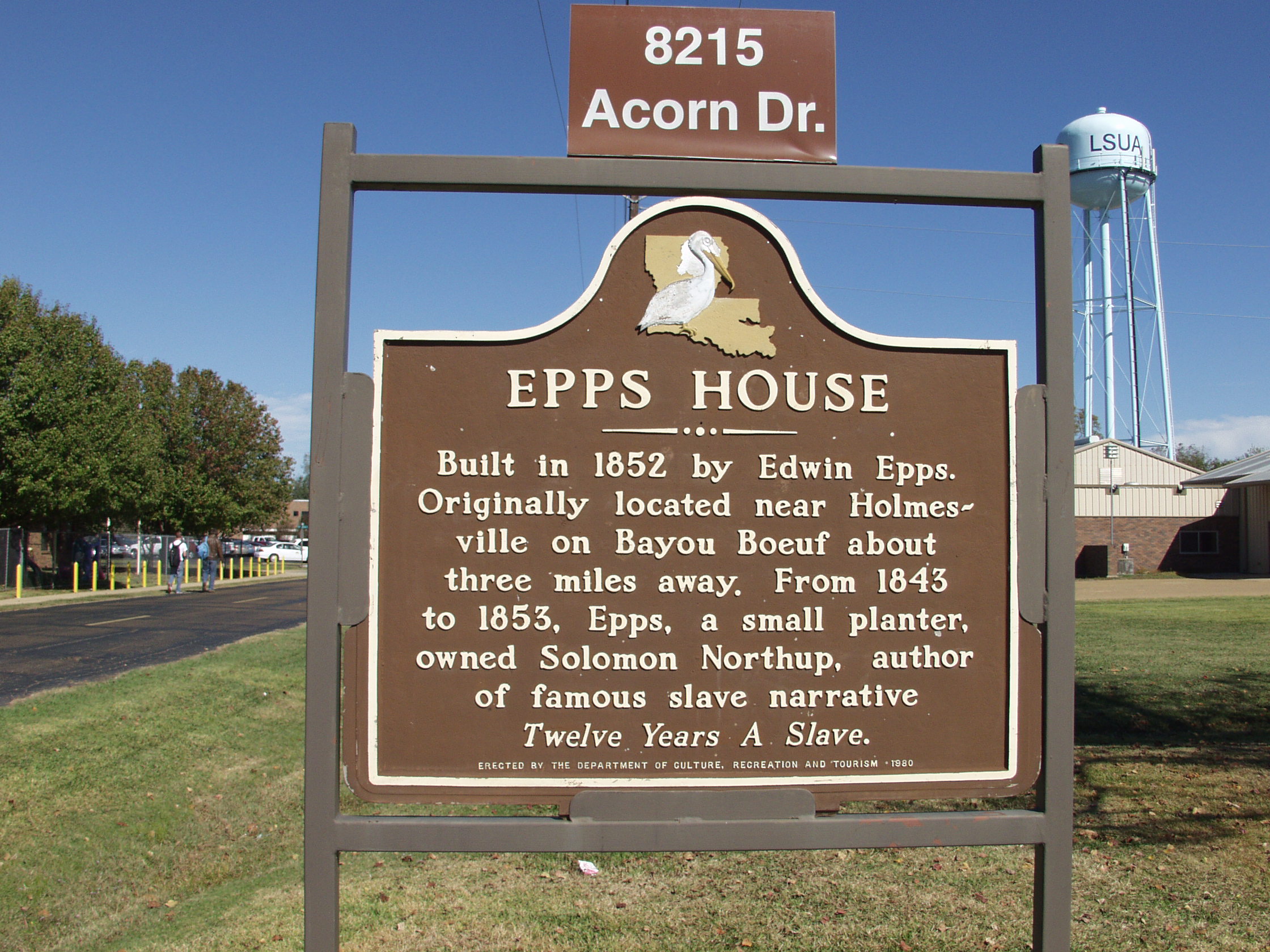
Edwin Epps was Northup's fourth and final slave owner. Northup was a slave on Epps' plantation for ten years and remembers him as having a "sharp, inquisitive expression" and "manners [that were] repulsive and coarse." In 1845 Epps purchased the roughly 300 acre plantation. 1850 U.S. Federal Census Slave Schedules show he owned 8 slaves between the ages of 40 and 11, six males, one of whom was Northup, and two females. In 1852 Solomon began work on the house on this property. During this construction he met Samuel Bass, a Canadian carpenter.  
The Edwin Epps House was originally located along the banks of Bayou Boeuf on Carl Hunt Road off of Highway 1176 outside of Bunkie.
The Epps Plantation was located here

Epps House in 1976 before it was moved
It was moved into Bunkie in 1976 for the purpose of becoming a museum, however, it was later purchased by LSU-Alexandria and is currently on the campus operating as a museum.  

Epps house after it was moved to the campus of LSU-Alexandria and refurbished
Epps Plantation as it looks now
From Civil War Album...
We were told the [Epps] home escaped being torched, like the rest, by Union troops because some of the New York soldiers had read the book Twelve Years A Slave by Solomon Northup who was a slave of the Epp's Family. The house is now located near the site of the Chambers Plantation which was destroyed by Union troops and fought over in May 1864.

An Earlier Gordon Parks Adaptation

In 1984, Gordan Parks made a movie for PBS based on 12 Years a Slave.

From Nola.com…
Gordon Parks' 1984 adaptation of Northup's memoirs, "Solomon Northup's Odyssey," -- which aired on PBS as part of its American Playhouse series -- starred Avery Brooks in the title role, as a free man of color living in New York state who was kidnapped and sold into slavery in 1841. 


History is Silent

From the WSJ…
The available evidence suggests that after his freedom, Northup’s life was anything but quiet and contemplative. Indeed, his final years are a bona fide mystery, even today, with a string of tantalizing clues. 
His last public sighting mentioned in a newspaper was in 1857, only four years after his freedom. 
Empathetic to the plight of slaves, documents show Northup almost certainly joined the Underground Railroad after his freedom— an illegal and extremely dangerous line of work, something that would sate his notable desire for adventure. He became a prolific speaker, joining Frederick Douglass and other major abolitionists in addressing Northeast audiences eager to hear his story first-hand. He also became a property owner in Glens Falls, N.Y. 
But despite all the newfound fame and purpose he found, money woes plagued him. In 1854, lenders foreclosed on his property. Other creditors won judgments against him over failure to repay loans he incurred, possibly to finance his speaking trips or assist slaves. A play he wrote (and starred in) based on the book had been a flop. 
Many believed his two kidnappers, driven by revenge for their trial, murdered Northup, but that fate is dismissed by the historians as “not credible.” Another possibility that he was kidnapped a second time is also noted, but dismissed. 
There are a few convincing theories on Northup’s final years. One is that Northup “died destitute, far from family and friends, perhaps under tragic circumstances,” the historians write. There is evidence he could have even “given up, resorted to drink, or sunk below the surface.” Or he may have gone to live with his daughter in Virginia. Clues are scarce. 
For all their research, Solomon Northup’s final days are a mystery still. 

Tuesday, November 19, 2013

Four Score and Seven Years Ago...


Immense quality can be found in brevity. Current politicians could do themselves a favor by learning this lesson.

From Abraham Lincoln Online...
There are five known copies of the speech in Lincoln's handwriting, each with a slightly different text, and named for the people who first received them: Nicolay, Hay, Everett, Bancroft and Bliss. Two copies apparently were written before delivering the speech; the remaining ones were produced months later for soldier benefit events. Despite widely-circulated stories to the contrary, the president did not dash off a copy aboard a train to Gettysburg. Lincoln carefully prepared his major speeches in advance; his steady, even script in every manuscript is consistent with a firm writing surface, not the notoriously bumpy Civil War-era trains. Additional versions of the speech appeared in newspapers of the era, feeding modern-day confusion about the authoritative text.
"Four score and seven years ago our fathers brought forth on this continent, a new nation, conceived in Liberty, and dedicated to the proposition that all men are created equal.

Now we are engaged in a great civil war, testing whether that nation, or any nation so conceived and so dedicated, can long endure. We are met on a great battle-field of that war. We have come to dedicate a portion of that field, as a final resting place for those who here gave their lives that that nation might live. It is altogether fitting and proper that we should do this.

But, in a larger sense, we can not dedicate -- we can not consecrate -- we can not hallow -- this ground. 
The brave men, living and dead, who struggled here, have consecrated it, far above our poor power to add or detract. The world will little note, nor long remember what we say here, but it can never forget what they did here. It is for us the living, rather, to be dedicated here to the unfinished work which they who fought here have thus far so nobly advanced. It is rather for us to be here dedicated to the great task remaining before us -- that from these honored dead we take increased devotion to that cause for which they gave the last full measure of devotion -- that we here highly resolve that these dead shall not have died in vain -- that this nation, under God, shall have a new birth of freedom -- and that government of the people, by the people, for the people, shall not perish from the earth."

Abraham LincolnNovember 19, 1863

Thursday, September 19, 2013

One Good Turn...


A nice start to the day.

From MSNBC...

Honesty really paid off for a homeless man in Boston who turned in a backpack worth nearly $42,000 earlier this week. 
Since his good deed, an online fundraiser had raised more than $92,000 for Glen James by early Thursday, and brought in offers from strangers who want to help the Good Samaritan by donating computers and offering health care services to him. 
Whittington, an accounts manager for a marketing firm, set up the fundraiser on the online donation site GoFundMe on Tuesday expecting "maybe a couple hundred bucks over the next couple of weeks," but set his goal at $50,000. 
"I figured he found [about] $41,000, let's give him $50,000," he said. "I didn't expect what we've received. I'm ecstatic about it."

Sunday, September 1, 2013

Thy Brother's Keeper

An inspiring story about a sacrifice made by Arthur Ashe's brother, Johnnie, that quite possibly changed the course of history.

From HBO...
 
I had the honor of meeting Mr. Ashe in 1986 and will always remember how gracious and kind he was.

Sunday, July 28, 2013

A Final Dance


Touching.

From MSN...
Realizing her ailing father won't be alive to share a dance with her at her future wedding, 25-year-old Rachel Wolf decided to hold a fake, groomless wedding just so that dance could take place. Dr. James Wolf, who is losing his battle with pancreatic cancer, was invited to his daughter's wedding in Auburn, Calif., despite the fact that she's not engaged. All decked out in their wedding attire, James and Rachel shared a dance to "Cinderella" by Steven Curtis Chapman in a park gazebo.

Saturday, July 27, 2013

Nada's Story


A powerful video and story about a young Yemeni girl fighting to live her life. 

From TYWKIWDBI...
When Nada tried to express her wish to go back to her uncle, she was shocked with the news that she was getting married. “They told me that I am engaged and that my fiance had already paid them money and brought the engagement ring. They said that I couldn’t leave and even threatened to kill me if I went back to my uncle.”.. 
After her uncle learned of what had happened, he went and took her from Hodeida back to Sanaa. Later on Nada and her uncle discovered that her parents have issued a statement that their daughter had been kidnapped by her uncle. “They said that my uncle kidnapped me but it’s not true, I am the one who ran away.” 
“I want to continue my education and live my life. I have many dreams, I don’t want to be married now. My mother hates me, she just wants me to get married because she will get money from the man. But I’m not an item for sale, I’m a human being and I would rather die than get married at this age."
Nada is now waiting in hopes that journalists, human-rights activists and different local organizations will help her make a strong case against her parents who are trying to get her back so they can go on with the marriage process.

Friday, July 19, 2013

Madiba's 95th

In honor of Nelson Mandela's 95th birthday here's a recording from 1961 of his first TV interview...

Tuesday, March 19, 2013

"Waste Land"


I've never watched the same movie twice in two weeks until I saw Waste Land.  In a nutshell, it's about garbage and beautiful people but of course, it's much more than that.

You can catch if on Netflix streaming.


Sunday, March 3, 2013

"To This Day"


Two stories, one subject: Bullying.

From HuffPo...
Viewed more than 4.3 million times (and counting), the soul-expanding video tells the stories of bullied children and focuses not only on the trauma of isolated youth and the battle to overcome emotional scars, but also on the hope of a better tomorrow. 
The poet, who has also launched a "To This Day" anti-bullying project, explained on the project's website that his own experiences with bullying as a youngster inspired him to want to confront and raise awareness about this widespread problem. 
"My experiences with violence in schools still echo throughout my life but standing to face the problem has helped me in immeasurable ways," he said on the site. 
According to DoSomething.org, "over 3.2 million students are victims of bullying each year." Additionally, one in seven students in grades K-12 is said to be involved in bullying -- whether as a bully or a bullying victim.
And the impact on both can last decades.

From Reuters...
Researchers have known that bullying can take a psychological toll on both bullies and victims, but it's been unclear just how long those effects would last. 
In the new study, depression and anxiety tied to bullying at school persisted at least through people's mid-twenties. Worst off were those who had been both bullies and targets of bullying, according to findings published Wednesday in JAMA Psychiatry.

Thursday, February 14, 2013

Thursday, January 31, 2013

Sight Unseen

I never would have guessed that skating and coffee could be so inspiring...


Sunday, January 13, 2013

Kiva

What happens when 620,000 lenders fund 615,000 entrepreneurs, students, and other microfinance borrowers around the world?

Five+ years of Kiva loan activity, in full color. (Thx Anders GS)


I posted about Kiva in early 2009 after my first loan. 108 loans later, I'm still at it. The key is Kiva's auto lending function which makes it very easy to lend. Just set your loan and auto-pay criteria and forget about it. 

Currently, I automatically increase my lending balance $25 every month and lend exclusively to women entrepreneurs, primarily in Africa, with businesses in the Agriculture, Arts, Education, Food, and Health sectors. 

If you need some cash, it's easy to withdraw your funds from Kiva. On my loans thus far, I've had 0% defaults, a .87% delinquency rate, and only a .01% currency exchange loss. So essentially, no principal loss at all over four years.  I'm doing much better than U.S. banks. 

Saturday, January 12, 2013

Generosity


Just watch the video. (thx Ginger MC)

From CBS News...
"Kindness creates kindness. Generosity creates generosity. Love creates love," he said. "And I think if we can share some of that and have more stories about people doing nice things for other people, and fewer stories about people doing horrible things to other people, that's a better world."

LinkWithin

Related Posts