Showing posts with label Cure All. Show all posts
Wednesday, January 1, 2014
Say Cheese
I've been planning for awhile to turn my experimentation to cheese. After months of procrastination and reading a lot of recipes and websites I finally ordered some cultures and molds a couple of weeks ago.
The thing about cheese, for the good ones we're most familiar with, i.e. Brie, Parmesan, Blue, English Cheddar, etc., it takes from 2-14 months for the cheese to age and ripen. Being relatively impatient to get this going, I decided to try a couple of soft cheeses first since they don't require a cheese press and the aging time is lot less. The first one I made is robiola from raw cow's milk (pictured above). We ate one wheel last Friday and three wheels are still aging in the "cheese cave", aka a mini fridge given to me by a good friend (thx AG!). For lack of a better description it's quite cheesy (clearly my cheese vocabulary needs some work) but with a good tangy flavor that I think will age well over the next month or so.
Next up was chèvre made with raw goat milk from our CSA. This one was easy. It didn't need to age so we ate a good portion of it the next day. If speed of consumption is an indication of it's taste, it went fast.
The recipes for both the robiola and the chèvre can be found here at the appropriately named cheesemaking.com.
Coming up…homemade Mozzarella this Friday for pizza.
Update: Although the fresh robiola was good, I had to toss the 30-day old aged robiola. It was too salty and although I removed all of the mold it still had a moldy flavor to it. C'est la vie.
Thursday, September 5, 2013
Mustard & Ketchup
That was no small assignment.
Over the course of a several weeks (there was a lot and it's a pain) I stripped the dried pods from the plants (I eventually got smart and used gloves after several pods impaled my hand), thrashed the pods to release the seeds (a pillowcase and rolling pin were handy), then did my best to separate the chaff from the seeds (blowing or a light breeze works well but it's a tricky step without blowing the seeds away).
Finally, there were no more pods and I had about 1/3 of a cup of black mustard seeds -- and a tiny bit of chaff. I was ready to make moutard.
There are a ton of homemade mustard recipes on the net but I decided to go with one by David Lebovitz figuring that since his ice cream recipes are good his mustard is probably tasty too. The mustard seeds get combined with white wine, Champagne vinegar, turmeric, salt, a pinch of cayenne, and a little maple syrup...sounds strange but that's what the recipe called for and I happened to have a yummy bottle of bourbon maple syrup that a guy about a mile away produces. The mixture sits for two days to soften the seeds and combine the flavors and then off to the blender.
Immediately after it's blended it tastes awful, very bitter almost astringent. But let it cure in the fridge for a minimum of 2-3 days and that flavor vanishes.
It's a lot of work to grow, harvest, thrash, collect, and clean mustard seeds to make a cup or so of mustard. At one point I was sure I'd never do it again but now I'm less certain.
The final product... delish! Possibly the most flavorful mustard I've had.
Because I used black mustard seeds it has the strength of a Dijon but also the depth of flavor of a good whole grain. I just might add a touch of bourbon to it though.
My wife also made a yummy curry ketchup from our garden tomatoes. That stuff it crazy good too.
Update: After several days, in order to thin it out a bit and cut the heat I added 3-4 tbsp of bourbon, 2 tbsp, and 1 tbsp of honey.
Sunday, June 23, 2013
Kefir
We've been drinking quite a bit of kefir lately. So like several things that we consume a lot of I thought I'd try to make it.
If you're not familiar with kefir, it's somewhat like a pourable yogurt and it's better for you in a variety of ways.
From Chris Kresser...
So last Saturday I took the 30 minute drive north and retrieved the grains from her mailbox and left a bottle of homemade habanero hot sauce in return. Less than 24 hours later we had our own kefir which I blended with some strawberries and banana. Although it's not less expensive than the store bought variety (organic milk and fruit can add up) it taste better and fresher than the store bought version and I know what's in it.
If you want some grains lets me know.
If you're not familiar with kefir, it's somewhat like a pourable yogurt and it's better for you in a variety of ways.
From Chris Kresser...
Kefir is a fermented milk product that originated centuries ago in the Caucasus mountains, and is now enjoyed by many different cultures worldwide, particularly in Europe and Asia. It can be made from the milk of any ruminant animal, such as a cow, goat, or sheep. It is slightly sour and carbonated due to the fermentation activity of the symbiotic colony of bacteria and yeast that make up the “grains” used to culture the milk (not actual grains, but a grain-like matrix of proteins, lipids, and sugars that feed the microbes). The various types of beneficial microbiota contained in kefir make it one of the most potent probiotic foods available.
Besides containing highly beneficial bacteria and yeasts, kefir is a rich source of many different vitamins, minerals and essential amino acids that promote healing and repair, as well as general health maintenance. Kefir contains high levels of thiamin, B12, calcium, folates and Vitamin K2. It is a good source of biotin, a B vitamin that HELPS the body assimilate other B vitamins. The complete proteins in kefir are already partially digested, and are therefore more easily utilized by the body. Like many other dairy products, kefir is a great source of minerals like calcium and magnesium, as well as phosphorus, which helps the body utilize carbohydrates, fats and proteins for cell growth, maintenance and energy.Making it is easy. It's as simple as putting the grains in some milk and letting it sit out overnight. The more difficult part was finding the kefir grains. Fortunately, I found a post from over a year ago on a kefir focused listserv (what isn't on the net?) by a woman who was kind enough to offer to give folks kefir grains -- they multiply as you use them.
So last Saturday I took the 30 minute drive north and retrieved the grains from her mailbox and left a bottle of homemade habanero hot sauce in return. Less than 24 hours later we had our own kefir which I blended with some strawberries and banana. Although it's not less expensive than the store bought variety (organic milk and fruit can add up) it taste better and fresher than the store bought version and I know what's in it.
If you want some grains lets me know.
The First Cure
After months of saying I was going to do it, I finally took the leap into homemade charcuterie. I started off with what everyone says is the easiest: duck prosciutto.
There's a gazillion recipes on the net that so I won't go into detail but here are a few pics of the process.
So how'd it turn out?
I followed the instructions to a tee and let the duck breasts decline in weight by 30% over the course of two weeks but they seem a bit dry. It could have been the size of the breasts (a bit small) or that the temperature wasn't constant nor within the specified range of 45-65F -- my fridge for curing only goes up to 41. Also the humidity level was significantly lower than recommended. Details details! In any event, despite all that, the flavor is quite good.
I've since brought an external temperature controller for the fridge so no worries about it being too cold any more. Now I have to work on a solution for humidity.
Next up. Bacon.
There's a gazillion recipes on the net that so I won't go into detail but here are a few pics of the process.
So how'd it turn out?
I followed the instructions to a tee and let the duck breasts decline in weight by 30% over the course of two weeks but they seem a bit dry. It could have been the size of the breasts (a bit small) or that the temperature wasn't constant nor within the specified range of 45-65F -- my fridge for curing only goes up to 41. Also the humidity level was significantly lower than recommended. Details details! In any event, despite all that, the flavor is quite good.
I've since brought an external temperature controller for the fridge so no worries about it being too cold any more. Now I have to work on a solution for humidity.
Next up. Bacon.
Saturday, August 18, 2012
This Week's Jerky
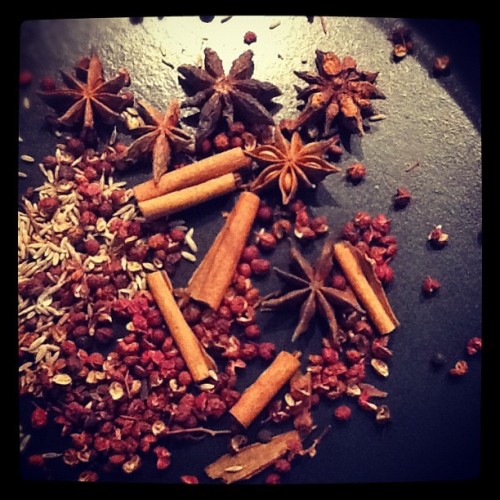
Chinese Five Spice.
It's a multi-day process so I haven't tasted it yet but I think it has a lot of potential.
The recipe is here.
It's a multi-day process so I haven't tasted it yet but I think it has a lot of potential.
The recipe is here.
Friday, July 20, 2012
Single Malt Jerky
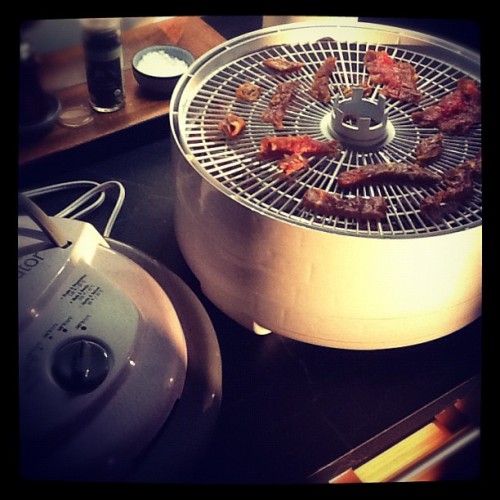
Now that we have a bit more storage space we finally got a dehydrator -- this thing is going to get a work out. First up, a repeat batch (sorta) of Spicy Bourbon Honey beef jerky we made in OAK back in January.
The problem: I'm very short-sighted. I drank all the bourbon.
The solution: Use 14yo single malt Caribbean cask Balvenie instead. Uh, yeah!
I made a few other mods to the original recipe to give it a little more ummph:
- Replace 2 tbsp chipotle powder with 1 tbsp cayenne and 1 tbsp smoked paprika
- Replace 1.5 tbsp salt with an equal amount or slightly more soy sauce
- Add 1 teaspoon cumin
The other GIGO: Goodness In, Goodness Out.
Sunday, February 19, 2012
This Little Piggy
![]() |
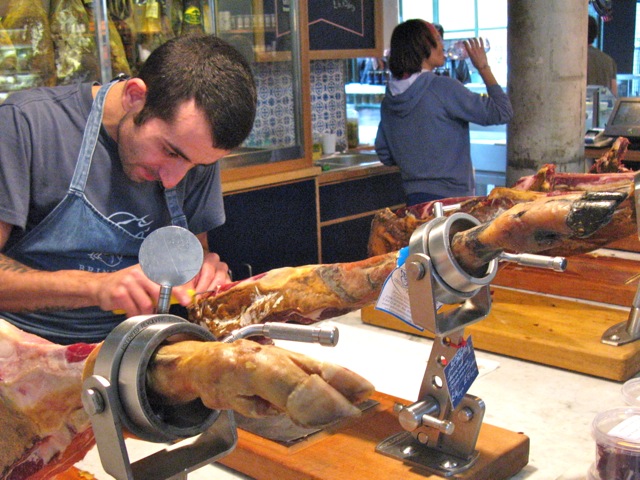
| Iberico de bellota carefully hand sliced at Borough Market, London |
There are only a few foods that I'll passionately seek out when I'm on the road: ice cream from Bertillon in Paris, sushi at the Tsukiji market in Tokyo, mangosteens in SE Asia, and iberico de bellota whenever in Europe.
It's a hard call, but that last one, iberico de bellota, just might be the best thing I've ever tasted.
From the the Boston Globe...
It weighs 13 pounds, glistens with fat, and is capped by a dramatic black hoof.Fine swine indeed.
It's a ham, but not just any ham. This is jamon iberico de bellota, the be-all-and-end-all, Rolls Royce, ne plus ultra of hams: one that positively demands a party.
Jamon iberico's cult following stems in part from its mystique: nearly unattainable, dearly expensive.
Its provenance adds to that; the ham comes from pigs that are as coddled as the cattle that become Kobe beef. The pigs roam free, feasting on acorns ("bellotas" in Spanish). "They live in pig paradise," says Harris. "They grow up as a gang together for two years, then when it's time for them to meet their maker, they play them Mozart. After Mozart, they go to bed for the night. I don't know if they're tucked in. The next morning they get hot showers, then some mysterious carbon dioxide enters their atmosphere and they go off to piggy heaven." This is referred to not as slaughtering the pigs, but as sacrificing them. The hams then cure for up to four years in clean mountain air.
The piggy spa treatment takes place for a practical reason. "They want them very mellow," Harris says. "If they're scared, they produce epinephrine. If they're not stressed, the meat is fine. I'm not saying the ham people are pig lovers. They're meat lovers."
The main reason bellota ham is so coveted, of course, is its flavor. "It's very meaty, rich, marbled with fat," writes Andres. "Jamon iberico is the finest ham in the world. It is a ham that will ruin you for other hams."
Thursday, January 12, 2012
Smoke It
Thanks to my brother-in-law's wonderful family and his mom who lugged it over from Sweden, we now have a new culinary gizmo with which to experiment...a smoker.
First up was the dish that led to our initial smoker infatuation during our Sweden visit, aspen smoked trout.
Next came a first time experiment in making beef jerky. And experiment we did. Spicy Bourbon Honey beef jerky, half with smoke and half without.
Fantastically delicious and a great snack for a cross-country flight.
Thanks to my Swedish family, I'm now solidly on the smokey path but I promise, I won't smoke the TV.
Here's the jerky recipe, sans smoke.
First up was the dish that led to our initial smoker infatuation during our Sweden visit, aspen smoked trout.
Next came a first time experiment in making beef jerky. And experiment we did. Spicy Bourbon Honey beef jerky, half with smoke and half without.
Fantastically delicious and a great snack for a cross-country flight.
Thanks to my Swedish family, I'm now solidly on the smokey path but I promise, I won't smoke the TV.
Here's the jerky recipe, sans smoke.
Subscribe to:
Posts (Atom)