Showing posts sorted by relevance for query i cried. Sort by date Show all posts

Tuesday, November 4, 2008

Wow: I Cried (Twice)

I realize that on hundreds of blogs, newspapers and magazines there will be numerous personal reflections on what the election of Barack Obama means to individual citizens. In that light, this post isn’t so much for the readers of this blog but for my own benefit. It's so that I may capture my thoughts and feelings at this precise historic moment before they become distant memories of the past.

A few thoughts and recollections...

Like many people, my first exposure to Obama was his keynote speech during the 2004 Democratic Convention. At that point, I knew within my heart and within my head that this was a man to watch because it was just a matter of time before he ran for President.

I didn’t anticipate that it would happen so soon but once he threw his hat into the race I was a staunch supporter.

During the primary season I quickly developed a hunger for all things political and began to voraciously read blog after blog after blog devoted to analysis of the primary race and the polling reports. I had numerous conversation with very close friends (some of whom were supporters of Clinton) that Obama could and would beat Clinton. Most thought I was a tad out in left field but I stuck to my instincts. My vindication came in February when Obama went on a romp and won primary after primary after primary. My spirits soared with the expectation that we would soon have our first African-American Democratic nominee for President. My spirits soured as Clinton hung on to a pipe dream, refused to concede, and turned the remaining primaries into an exercise in mudslinging.

Finally, the day in June arrived when Clinton conceded and Obama was then just weeks away from accepting the nomination at the Democratic convention. It was a memorable day.

Obama’s acceptance speech at the convention, just as his speech after the Iowa primary and his speech during the midst of the Wright controversy was truly inspiring. It instilled in me a sense of faith and trust in the government that I have never felt before. Finally, the end was in sight and I couldn’t wait for the next few months to pass. I was fired up and ready to go so I pitched in the best way I could by donating more money, raising funds via my blog, buying stuff off Obama’s website, spreading the word as much as I could, and even baking cookies with my wife and niece for an Obama bake sale.

What followed was a gneral election campaign that was a study in inclusiveness...black, white, yellow, brown, gay, straight, old, young…people from every walk of life came together to support this man with “the funny last name”. It was beautiful and magical.

Then the campaign turned dirty from McCain’s desperate, cynical and devisive tactics. It was dreadful and depressing to watch the worse in some Americans on display. Yet it was a reminder that although this country has come a very long way there are still pockets of racism, xenophobia and intolerance that have yet to be extinguished.

Finally today arrived, I patiently stood in the voting line for two hours. When it was my turn I savored the historical moment then proudly cast my vote for Obama. I left the polls and drove to work, passing by the White House with hopes that that building will soon be the new home of Barack, Michelle and their daughters.

It’s cliché to say I never thought I’d see this day, but it’s true. My mother and father both lived through and were victims of segregation. I wish my father were alive to see this day because I know he would love it as much as I do. Fortunately my mother is here. As I write this I sit in a hospital room with her as she recovers from surgery and other related illnesses (I’m not leaving her side until Obama wins). Since she was unable to vote, I symbolically cast half of my vote for my mother and half for me. In reality, the vote was not cast for either of us. It was cast for my nieces and nephews, for those who have yet to be born, for the environment, for global peace, for the future of our country and ultimately the future of the world.

The moment came when the networks called the election for Obama.

I cried.

Obama gave his acceptance speech.

I cried, again.

Regardless of how successful Obama’s term is, this day November 4th, 2008 is an extraordinary turning point in history.

I am proud to have witnessed and contributed to this history.

I am proud to be a citizen of the United States.

I am proud of President-elect Barack Obama.

Change has come.

Wednesday, November 4, 2009

I Cried (Twice) Redux

365 days can go by very fast. A lot has happened in the past year, some things were joyful others extraordinarily painful. Nonetheless, 365 days ago marked a turning point for this country and the world and for that reason alone I want to acknowledge the historical significance of this day. Reposted in full are my thoughts on November 4, 2008.

I realize that on hundreds of blogs, newspapers and magazines there will be numerous personal reflections on what the election of Barack Obama means to individual citizens. In that light, this post isn’t so much for the readers of this blog but for my own benefit. It's so that I may capture my thoughts and feelings at this precise historic moment before they become distant memories of the past.

A few thoughts and recollections...

Like many people, my first exposure to Obama was his keynote speech during the 2004 Democratic Convention. At that point, I knew within my heart and within my head that this was a man to watch because it was just a matter of time before he ran for President.

I didn’t anticipate that it would happen so soon but once he threw his hat into the race I was a staunch supporter.

During the primary season I quickly developed a hunger for all things political and began to voraciously read blog after blog after blog devoted to analysis of the primary race and the polling reports. I had numerous conversation with very close friends (some of whom were supporters of Clinton) that Obama could and would beat Clinton. Most thought I was a tad out in left field but I stuck to my instincts. My vindication came in February when Obama went on a romp and won primary after primary after primary. My spirits soared with the expectation that we would soon have our first African-American Democratic nominee for President. My spirits soured as Clinton hung on to a pipe dream, refused to concede, and turned the remaining primaries into an exercise in mudslinging.

Finally, the day in June arrived when Clinton conceded and Obama was then just weeks away from accepting the nomination at the Democratic convention. It was a memorable day.

Obama’s acceptance speech at the convention, just as his speech after the Iowa primary and his speech during the midst of the Wright controversy was truly inspiring. It instilled in me a sense of faith and trust in the government that I have never felt before. Finally, the end was in sight and I couldn’t wait for the next few months to pass. I was fired up and ready to go so I pitched in the best way I could by donating more money, raising funds via my blog, buying stuff off Obama’s website, spreading the word as much as I could, and even baking cookies with my wife and niece for an Obama bake sale.

What followed was a gneral election campaign that was a study in inclusiveness...black, white, yellow, brown, gay, straight, old, young…people from every walk of life came together to support this man with “the funny last name”. It was beautiful and magical.

Then the campaign turned dirty from McCain’s desperate, cynical and devisive tactics. It was dreadful and depressing to watch the worse in some Americans on display. Yet it was a reminder that although this country has come a very long way there are still pockets of racism, xenophobia and intolerance that have yet to be extinguished.

Finally today arrived, I patiently stood in the voting line for two hours. When it was my turn I savored the historical moment then proudly cast my vote for Obama. I left the polls and drove to work, passing by the White House with hopes that that building will soon be the new home of Barack, Michelle and their daughters.

It’s cliché to say I never thought I’d see this day, but it’s true. My mother and father both lived through and were victims of segregation. I wish my father were alive to see this day because I know he would love it as much as I do. Fortunately my mother is here. As I write this I sit in a hospital room with her as she recovers from surgery and other related illnesses (I’m not leaving her side until Obama wins). Since she was unable to vote, I symbolically cast half of my vote for my mother and half for me. In reality, the vote was not cast for either of us. It was cast for my nieces and nephews, for those who have yet to be born, for the environment, for global peace, for the future of our country and ultimately the future of the world.

The moment came when the networks called the election for Obama.

I cried.

Obama gave his acceptance speech.

I cried, again.

Regardless of how successful Obama’s term is, this day November 4th, 2008 is an extraordinary turning point in history.

I am proud to have witnessed and contributed to this history.

I am proud to be a citizen of the United States.

I am proud of President-elect Barack Obama.

Change has come.

Friday, November 22, 2013

12 Years a Slave 160 Years Later

After we watched the superb film 12 Years a Slave yesterday evening (if you haven't seen it…GO!), I spent this morning delving deeper into Solomon Northup's life as well as a variety of other aspects of the movie.

Here's what I've learned:

Descendants of Solomon Northup

From Nola.com
McQueen was just finishing up a post-screening Q-and-A with "12 Years a Slave" actors Chiwetel Ejifor and Lupita Nyong'o when he was informed a special guest was in the audience.  Her name: Evelyn Jackson and, McQueen was told, she is a descendant of Northup, the man on whose memoirs McQueen's film is based.
I said, 'We've got an important announcement, please. This lady here is a direct descendant of Solomon Northup. "The crowd erupted. It was a standing ovation. Tears -- she was in tears. She goes, 'I need a hug!' So we embraced. It was just one of those -- I have goose pimples talking about it now. It was just one of those things where the film and the actual reality came together. So it was just -- yeah, it was magic."
Evelyn Jackson and Steve McQueen
From Saratoga Springs Visitor Center...
In 1999, in recognition of his life’s work, his ordeal and that of other African-Americans, native Saratogian, Renee Moore, founded “Solomon Northup Day – A Celebration of Freedom”. 
An historical marker was placed by the City of Saratoga Springs on Broadway at the side entrance of the Visitor Center marking the point of abduction.
Northup descendants from four states have attended the event over the years including, matriarch Victoria Northup Linzy Dunham who lived to age 98. 
Descendants of Solomon Northup in 1999
In 2002, the Saratoga Springs City Council proclaimed the third Saturday in July to be annually recognized as “Solomon Northup Day” and the “Celebration of Freedom” event is held at the Heritage Area Visitor Center every July.

Historical Locations in and near Washington, DC

Just as in the movie, the slave pen in which Northup was held was within sight of the U.S. Capitol. It was located on the site of what is now the FAA headquarters at 600 Independence Ave NW (across the street from the Air and Space Museum).

A slave market from which Northup was likely sold still stands in Old Town Alexandria at 1315 Duke St. It is now a museum and the headquarters of the Northern Virginia Urban League.

The Williams slave pen in Washington, DC was located here
From WUSA CBS...


Adherence to the Novel

As with most films adapted from a novel, there are several things that stray a bit from the book. Nonetheless, overall the film adhered fairly close to the narrative that Solomon Northup wrote.  An article from Slate touches upon several of the deviations.

A poignant scene from the film as originally written by Solomon Northup via Louisiana Tech...
"Good-bye, master." 
"Ah! you d——d nigger," muttered Epps, in a surly, malicious tone of voice, "you needn't feel so cussed tickled — you ain't gone yet — I'll see about this business at Marksville to-morrow." 
I was only a "nigger" and knew my place, but felt as strongly as if I had been a white man, that it would have been an inward comfort, had I dared to have given him a parting kick. 
On my way back toward the carriage, Patsey ran from behind a cabin and threw her arms about my neck. 
"Oh! Platt," she cried, tears streaming down her face, "you're goin' to be free — you're goin' way off yonder where we'll neber see ye any more. You've saved me a good many whipping, Platt; I'm glad you're goin' to be free — but oh! de Lord, de Lord! what'll become of me?" 
I disengaged myself from her, and entered the carriage. The driver cracked his whip and away we rolled. I looked back and saw Patsey, with drooping head, half reclining on the ground; Mrs. Epps was on the piazza; Uncle Abram, and Bob, and Wiley, and Aunt Phebe stood by the gate, gazing after me. I waved my hand, but the carriage turned a bend of the bayou, hiding them from my eyes forever.
The entire text of 12 Years a Slave is available via Louisiana Tech


The Real Samuel Bass

From The Spec
Morris and other descendants say they are only now discovering details about Bass, who left Canada sometime around 1840 and took on a series of carpentry jobs throughout the United States. 
It turns out that other aspects of his life were not so honourable — census records show he left behind a wife, Catherine Lydia Lane, and four daughters: Catherine, Hannah, Martha Maria and Zeruah Bass, says Bonnie Gaylord of the Grenville County Historical Society in Prescott, Ont. 
...John Pamplin Wadill's diary also offers clues to why Bass left his family. 
"He had been separated from his wife for 12 or 15 years," Wadill states in an entry dated Aug. 30, 1953, which also lists Bass's wife's name as Lydia Catlin Lane. "His only complaint against her was that she had such a temper as to preclude any man from living with her." 
The diary also raises the possibility that Bass may have had a second family in Louisiana, says Fiske. The diary notes Bass died of pneumonia at the home of a free woman of colour in Marksville, La., named Justine Tounier. It says Bass passed away Aug. 30, 1853, just months after Northup regained his freedom. 
"I suspect that there was a relationship (with Tounier) but the diary doesn't say," says Fiske, adding he also discovered the death record of a woman who appears to list Bass and Tounier as parents.

The Epps Plantation

Edwin Epps was Northup's fourth and final slave owner. Northup was a slave on Epps' plantation for ten years and remembers him as having a "sharp, inquisitive expression" and "manners [that were] repulsive and coarse." In 1845 Epps purchased the roughly 300 acre plantation. 1850 U.S. Federal Census Slave Schedules show he owned 8 slaves between the ages of 40 and 11, six males, one of whom was Northup, and two females. In 1852 Solomon began work on the house on this property. During this construction he met Samuel Bass, a Canadian carpenter.  
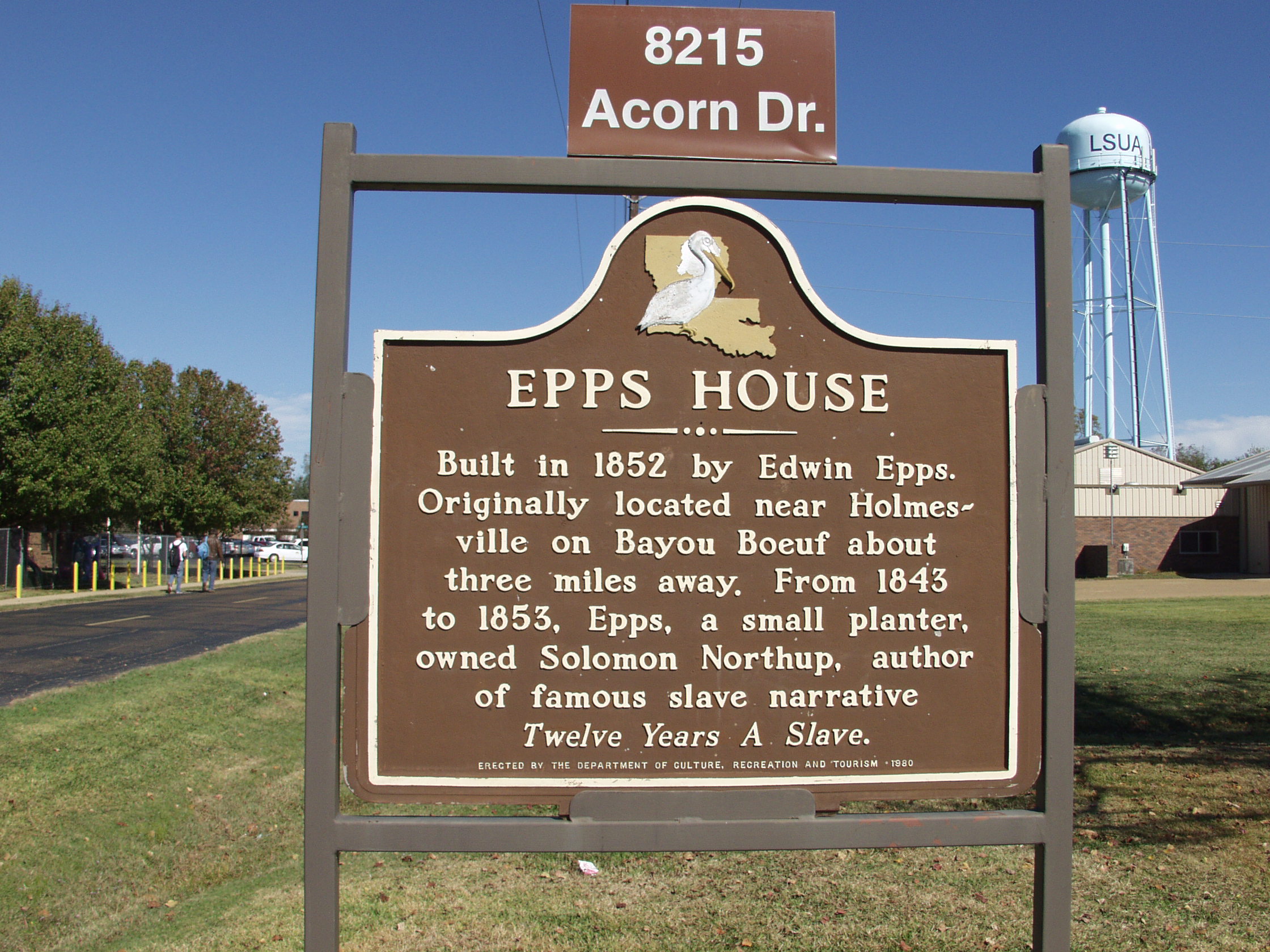
The Edwin Epps House was originally located along the banks of Bayou Boeuf on Carl Hunt Road off of Highway 1176 outside of Bunkie.
The Epps Plantation was located here

Epps House in 1976 before it was moved
It was moved into Bunkie in 1976 for the purpose of becoming a museum, however, it was later purchased by LSU-Alexandria and is currently on the campus operating as a museum.  

Epps house after it was moved to the campus of LSU-Alexandria and refurbished
Epps Plantation as it looks now
From Civil War Album...
We were told the [Epps] home escaped being torched, like the rest, by Union troops because some of the New York soldiers had read the book Twelve Years A Slave by Solomon Northup who was a slave of the Epp's Family. The house is now located near the site of the Chambers Plantation which was destroyed by Union troops and fought over in May 1864.

An Earlier Gordon Parks Adaptation

In 1984, Gordan Parks made a movie for PBS based on 12 Years a Slave.

From Nola.com
Gordon Parks' 1984 adaptation of Northup's memoirs, "Solomon Northup's Odyssey," -- which aired on PBS as part of its American Playhouse series -- starred Avery Brooks in the title role, as a free man of color living in New York state who was kidnapped and sold into slavery in 1841. 


History is Silent

From the WSJ
The available evidence suggests that after his freedom, Northup’s life was anything but quiet and contemplative. Indeed, his final years are a bona fide mystery, even today, with a string of tantalizing clues. 
His last public sighting mentioned in a newspaper was in 1857, only four years after his freedom. 
Empathetic to the plight of slaves, documents show Northup almost certainly joined the Underground Railroad after his freedom— an illegal and extremely dangerous line of work, something that would sate his notable desire for adventure. He became a prolific speaker, joining Frederick Douglass and other major abolitionists in addressing Northeast audiences eager to hear his story first-hand. He also became a property owner in Glens Falls, N.Y. 
But despite all the newfound fame and purpose he found, money woes plagued him. In 1854, lenders foreclosed on his property. Other creditors won judgments against him over failure to repay loans he incurred, possibly to finance his speaking trips or assist slaves. A play he wrote (and starred in) based on the book had been a flop. 
Many believed his two kidnappers, driven by revenge for their trial, murdered Northup, but that fate is dismissed by the historians as “not credible.” Another possibility that he was kidnapped a second time is also noted, but dismissed. 
There are a few convincing theories on Northup’s final years. One is that Northup “died destitute, far from family and friends, perhaps under tragic circumstances,” the historians write. There is evidence he could have even “given up, resorted to drink, or sunk below the surface.” Or he may have gone to live with his daughter in Virginia. Clues are scarce. 
For all their research, Solomon Northup’s final days are a mystery still. 

Friday, December 24, 2010

Nuns and Habits


I have a lot of respect for nuns. Actually, I have a lot of respect for anyone who has s singular devotion in life and pursues it with dogged persistence and passion, whether it's nuns, artists, scholars or chocolate makers.

Four out of my eight grades in elementary school were taught by nuns from the Sisters of St. Joseph order: Sister James (1st), Sister Marie (5th), Sister Elizabeth (7th), and Sister McGonigal (8th). Although Sister McGonigal came the closest, in general these nuns weren't the stern knuckle rapping nuns of myth but were more of the Flying Nun type -- quite nice and very good teachers.

But that was a long time ago in a galaxy far away and over the years I had assumed that joining a convent was a relic from a bygone era characterized by fewer opportunities for women and a stronger emphasis on religion. That's largely true except for an order of nuns in Nashville, TN.

From NPR...
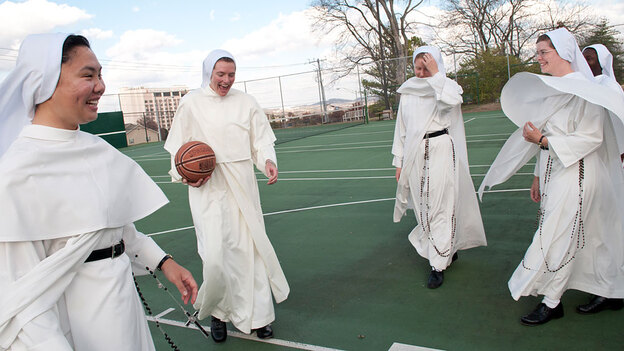
For the most part, these are grim days for Catholic nuns. Convents are closing, nuns are aging and there are relatively few new recruits. But something startling is happening in Nashville, Tenn. The Dominican Sisters of St. Cecilia are seeing a boom in new young sisters: Twenty-seven joined this year and 90 entered over the past five years.

The average of new entrants here is 23. And overall, the average age of the Nashville Dominicans is 36 — four decades younger than the average nun nationwide...

...And did they always want to be nuns?

"No," says Sister Beatrice Clark, laughing. "I didn't know they still existed."

Clark, who is 27, says she became aware of the religious life when she was a student at Catholic University in Washington. In her junior year, she began feeling that God was drawing her to enter a convent. Over Thanksgiving vacation in 2004, she broke the news to her family.

"My parents just sat there and looked at me," she says. "And they cried. And I said, 'I think I'm supposed to enter soon.' And my father said, 'This is the time of life to take leaps.' "

She joined the Nashville Dominicans on her 22nd birthday.

Friday, August 8, 2008

Wow: In Honor of Olympians Tommie Smith and John Carlos

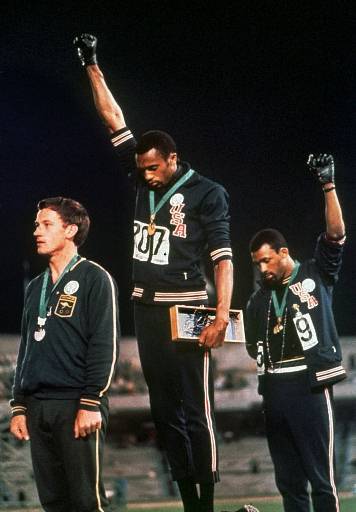
The year was 1968, I was 4 years old and have no recollection of the events that transpired at the Olympic Games in Mexico City. Yet, during the '68 Games, a nonviolent act of protest in support of the civil rights movement by Tommie Smith and John Carlos caused such an outrage that they were suspended from their national team and banned from the Olympic Village.

Years later, I recall a conversation I had while in grad school with my roommate and one of my best friends about this protest (I think he had a poster of it). Ever since, the photo of this one lone act as well as the protest itself has strongly resonated with me. To my surprise, in 2005 I was pleased to pick up the newspaper and read that a 20 ft. statue honoring Tommie Smith and John Carlos had been erected on the campus of San Jose State University. (Click here to read a recent Forbes article on Smith and Carlos)

Clearly the U.S. has come a long way in the last 40 years; however, as the Olympics begins today in China, let us not forget the people in the world that are still oppressed and struggling for civil rights...1.3 billion of which are in China.

It was the most popular medal ceremony of all time. The photographs of two black American sprinters standing on the medal podium with heads bowed and fists raised at the Mexico City Games in 1968 not only represent one of the most memorable moments in Olympic history but a milestone in America's civil rights movement.

The two men were Tommie Smith and John Carlos. Teammates at San Jose State University, Smith and Carlos were stirred by the suggestion of a young sociologist friend Harry Edwards, who asked them and all the other black American athletes to join together and boycott the games. The protest, Edwards hoped, would bring attention to the fact that America's civil rights movement had not gone far enough to eliminate the injustices black Americans were facing. Edwards' group, the Olympic Project for Human Rights (OPHR), gained support from several world-class athletes and civil rights leaders but the all-out boycott never materialized.

Still impassioned by Edwards' words, Smith and Carlos secretly planned a non-violent protest in the manner of Martin Luther King, Jr. In the 200-meter race, Smith won the gold medal and Carlos the bronze. As the American flag rose and the Star-Spangled Banner played, the two closed their eyes, bowed their heads, and began their protest.

Smith later told the media that he raised his right, black-glove-covered fist in the air to represent black power in America while Carlos' left, black-covered fist represented unity in black America. Together they formed an arch of unity and power. The black scarf around Smith's neck stood for black pride and their black socks (and no shoes) represented black poverty in racist America.

While the protest seems relatively tame by today's standards, the actions of Smith and Carlos were met with such outrage that they were suspended from their national team and banned from the Olympic Village, the athletes' home during the games.

A lot of people thought that political statements had no place in the supposedly apolitical Olympic Games. Those that opposed the protest cried out that the actions were militant and disgraced Americans. Supporters, on the other hand, were moved by the duo's actions and praised them for their bravery.


Saturday, July 25, 2009

Lady Day


My father used to tell a story about the time he was working at the Howard Theater in DC and was instructed to pick up Billie Holiday from where she was staying. He drove over and waited and waited and waited outside until finally Billie came out and got into the car. She was late because she was completely stoned. He told me he took her to the theater nonetheless and when she stepped onto the stage she "sobered" right up or at least appeared that way and sang and sang and sang only as Lady Day could.

From The Root...
Billie Holiday was obviously given much more than most, and her talent revealed itself through her intensity, her phrasing and her control of nuance more so than the conventional strengths of big sound, great range and stunning projection. Her voice was small, and her range was equally small. Standing next to most singers, she would never get you to put your money on her, unless you knew in advance that her emotional force and her ability to summon pathos, joy and melancholy with naked precision would demolish almost anyone intent on making a contest out of a hazardous moment on the bandstand with her.

There the story of one performance with super virtuoso Sarah Vaughan. Vaughan was so profoundly endowed with a superior instrument that she sometimes could not avoid strutting her stuff to the point of obnoxiousness. But the ax fell. When Vaughan called up “I Cried For You,” Holiday whispered, “You done screwed up now, bitch. That’s my song.”

LinkWithin

Related Posts