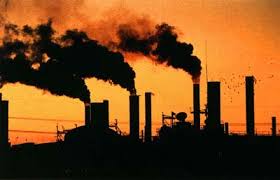
Everyone knows of many awful things that have happened because of the global recession but at least in one area the recession has had a positive impact.
It is no coincidence that some of the dirtiest industrial operations are falling victim to the global recession. Over the past two decades, much of the world's manufacturing moved to where pollution standards are little more than mild suggestions. Since small, corner-cutting, inefficient facilities tend to both flout pollution laws and be most vulnerable to a sudden drop in demand, the global recession has hit such operations especially hard.
Thousands of factories in China's Pearl River Delta have shut their doors since late last year, for instance. In India, enough small steel-rolling mills around Delhi have closed that levels of sulfur dioxide (which forms acid rain) fell 85 percent in October 2008 compared with a year earlier.
The recession is bringing a green dividend in the developed world, too. Reduced economic activity is projected to cut Europe's emissions of carbon dioxide, the chief man-made greenhouse gas, by 100 million tons in 2009, and the United States' by about the same amount.
I think I said it before but it's worth repeating...I love street art!
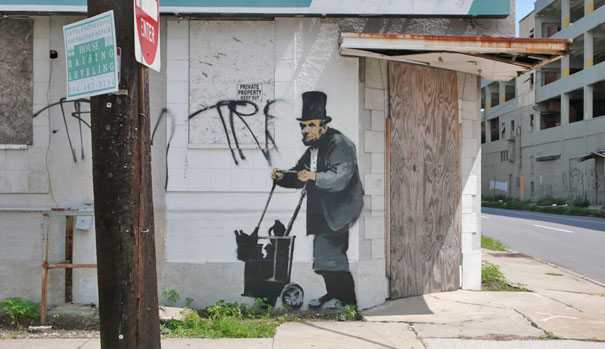
Santiago has it's fair share of very good street art. Last night we was wandering around Bellavista, the "Bohemian district" of Santiago and we came across what seemed like a Banksy stencil.
Up until a several weeks ago I had no idea who Banksy was (is). Actually, I still don't know much about him since it's the culture of street artists to maintain their anonymity for various reasons...one being jail. The one thing that folks are certain of is that Banksy is British, beyond that it's anyone's guess.
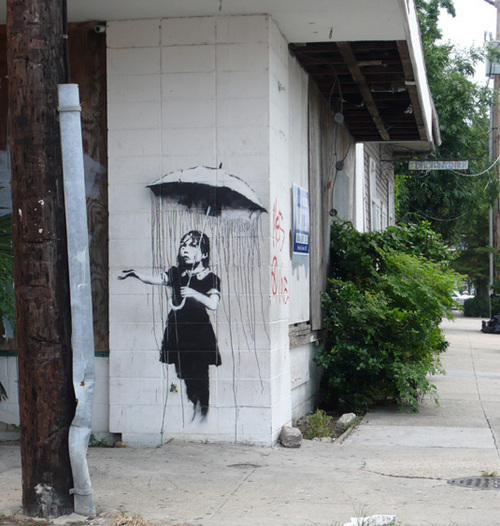
His art, which has appeared overnight in various cities around the world, is often satirical takes on topics such as politics, culture, and ethics. This past September, Banksy (or so most people believe) hit New Orleans overnight just days prior to the third anniversary of Katrina.
Whether Banksy did these new designs, they are by far the best guerrilla art ever seen on Crescent City masonry.On the corner of St. Claude Avenue and Kerlerec Street, you'll find a little girl hiding beneath an umbrella. Unfortunately this particular umbrella isn't protecting her in the least. Instead, it's drenching her in a silver waterfall -- the way certain presumably protective levees drenched the city three years ago.
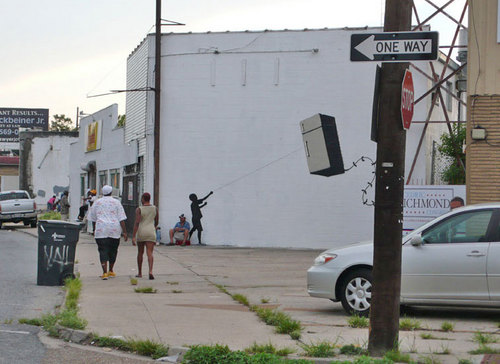
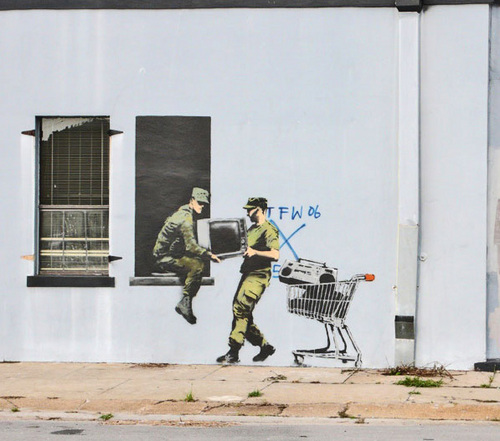
Out past the Industrial Canal on Claiborne Avenue, you'll spot a young boy swaying on a tire swing -- except this swing is really a life-preserver. The crippled man waving the American flag on St. Claude Avenue in the Lower 9th Ward seems oblivious to the NO LOITERING sign sprayed on the wall behind him. On the side of a St. Claude Avenue convenience store, a child flies what at first seems to be a kite, but is really that familiar post-flood symbol: a refrigerator. A pair of stenciled soldiers loot a building on Elysian Fields Avenue.
Whether you agree with his point of view, you'll agree Banksy's art is timely, poetic, and beautifully done. Banksy's designs are so far beyond the usual graffiti doodling that it's possible anyone can appreciate them -- if they ordinarily adore graffiti or despise it.
About that boy swinging on a life-preserver, well it seems that some folks don't quite appreciate Banksy's art and in the process probably flushed down the toilet a couple hundred thousand dollars (the going price from Sotheby's for some of Banksy's stencils). Duh!
For more on Banksy check out this video...
and this site and Banky's own site to see his latest work.
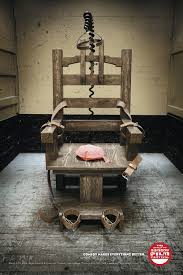
I'm staunchly against the death penalty due, in part, to two reasons: 1) innocent people have been sentenced to death and 2) the death penalty is applied disproportionately to minorities. According to The Innocence Project 17 people had been sentenced to death before DNA proved their innocence and led to their release.
Fortunately, the death penalty may be on the decline in several states and the reason is...the recession.
From MSNBC...
After decades of moral arguments reaching biblical proportions, after long, twisted journeys to the nation's highest court and back, the death penalty may be abandoned by several states for a reason having nothing to do with right or wrong:
Money.
Turns out, it is cheaper to imprison killers for life than to execute them, according to a series of recent surveys. Tens of millions of dollars cheaper, politicians are learning, during a tumbling recession when nearly every state faces job cuts and massive deficits.
So an increasing number of them are considering abolishing capital punishment in favor of life imprisonment, not on principle but out of financial necessity.
Clearly Obama's election was a transformational moment in this country's history. Now Barack is busy working to make his time in office a transformative presidency.
From a historical perspective the first step to becoming a "reconstructive leader" is to repudiate your predecessor and Obama has gotten a good start on that front.
From his inauguration address forward, President Obama hasn't pulled any punches in criticizing the record of his predecessor, George W. Bush. In that process--which reached a new peak with the release of the administration's budget plan last Thursday--Obama is aggressively employing a strategy used by the presidents who have most powerfully realigned the political landscape through American history. It is an approach that Yale University political scientist Stephen Skowronek has shrewdly termed "the authority to repudiate."
Skowronek noted that the presidents who most successfully constructed lasting electoral majorities all followed presidents widely viewed as failures. These repeated couplings between "manifest incapacity and towering success" have included John Adams and Thomas Jefferson in 1800; John Quincy Adams and Andrew Jackson in 1828; James Buchanan and Abraham Lincoln in 1860; Herbert Hoover and Franklin D. Roosevelt in 1932; and, most recently, Jimmy Carter and Ronald Reagan in 1980.
The White House took its indictment to a new level in the budget blueprint it released last Thursday. In a relentless 11 pages, the first chapter offers a withering point-by-point critique of Bush's economic record and governing performance, from anemic job creation and income growth (the median income among working-age families fell by nearly $2,000 from 2000 through 2007) to rising poverty (up by 5.7 million from 2000 through 2007). It denounces Bush as overly secretive ("It is no coincidence that the policy failures of the past eight years have been accompanied by unprecedented Governmental secrecy"), incompetent, fiscally irresponsible, short-sighted, ideologically rigid (pursuing "a dogmatic deregulatory approach") and favoring the rich over all others. The White House sums up the previous occupant's record this way: "This is the legacy that we inherit--a legacy of mismanagement and misplaced priorities, of missed opportunities and of deep, structural problems ignored for too long."
The airlines are getting way out of control with all their fees these days.
Last year USAir started charging for water (recently reversed), on JetBlue you have to fork over for a pillow and blanket, several other airlines charge for the first bag checked, now one airline is going to charge a fee just to buy a ticket and another is thinking about charging its captive audience to use the toilet!
Spirit Airlines Inc., an ultra-low-cost carrier that has pioneered many fees, says it has worked out an agreement with the U.S. Department of Transportation to begin charging a "passenger usage fee" -- perhaps $5 to $10 per ticket -- for the privilege of buying a ticket anyplace other than at Spirit's airport ticket counters.
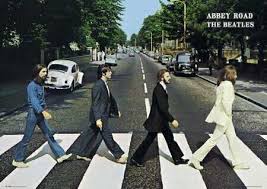
Liverpool Hope University has launched a brand new MA in The Beatles, Popular Music and Society, the first of its kind in the world.
The new course, which can be studied both full and part time, covers four modules with specific issues relating to The Beatles and Popular Music, consisting of four 12-week taught modules, plus a dissertation.
Mike Brocken, Senior Lecturer in Popular Music at Hope, said 'There have been over 8,000 books about The Beatles but there has never been serious academic study and that is what we are going to address.
For further information, please call the postgraduate enquiry line on 0151 291 3389.
Now maybe all those who have scotched getting an MBA can get an MBA of a different sort...Masters of Beatles Administration.
I'm not much of a doodler (or is it doodleler?), except of course when I'm extremely bored in a meeting. It's nice to know it has some benefit (remember that teachers!)
In a victory for absent-minded scribblers everywhere, one study now suggests that doodling can help your memory.
The results, published online Thursday in Applied Cognitive Psychology, suggest that the doodlers actually had better recall: on average they remembered 29 percent more information.
Doodling can be a good thing. If there's a choice between doodling and daydreaming, you're better off if your students are doodling. Of course, it's best if you aren't boring them at all, but doodling isn't necessarily a sign of your students being naughty—it's a sign that it may be hard for them to concentrate without something visual.
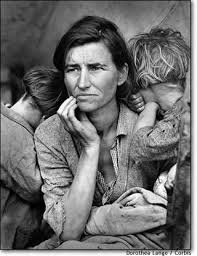
An interesting tidbit about the word "depression" from the AP...
Before the 1930s, any serious economic downturn was called a depression. The term "recession" didn't come into common use until "depression" became burdened by memories of the 1930s, said Robert McElvaine, a history professor at Millsaps College in Jackson, Miss.
"When the economy collapsed again in 1937, they didn't want to call that a new depression, and that's when recession was first used," he said.
Every now and then I come across a really good commercial, not that I'm particularly looking at a lot of commericals though.
This happens to be one.
To top it off not only do you get the commercial, as an added bonus you also get the special collectors edition of the "making of the commercial" video. How's that for a deal?
Icelanders are among the most inbred human beings on earth—geneticists often use them for research.
“You have to understand,” he told me, “Iceland is no longer a country. It is a hedge fund.”
This in a country the size of Kentucky, but with fewer citizens than greater Peoria, Illinois. Peoria, Illinois, doesn’t have global financial institutions, or a university devoting itself to training many hundreds of financiers, or its own currency. And yet the world was taking Iceland seriously.
...last October, Iceland’s 300,000 citizens found that they bore some kind of responsibility for $100 billion of banking losses—which works out to roughly $330,000 for every Icelandic man, woman, and child.
As he is already unsettled, I tell him about the unsettling explosions outside my hotel room. “Yes,” he says with a smile, “there’s been a lot of Range Rovers catching fire lately.” Then he explains.
Because Iceland is really just one big family, it’s simply annoying to go around asking Icelanders if they’ve met Björk. Of course they’ve met Björk; who hasn’t met Björk? Who, for that matter, didn’t know Björk when she was two? “Yes, I know Björk,” a professor of finance at the University of Iceland says in reply to my question, in a weary tone. “She can’t sing, and I know her mother from childhood, and they were both crazy. That she is so well known outside of Iceland tells me more about the world than it does about Björk.”
Before Alcoa could build its smelter it had to defer to a government expert to scour the enclosed plant site and certify that no elves were on or under it.
The fish had not only been privatized, they had been securitized.
Back away from the Icelandic economy and you can’t help but notice something really strange about it: the people have cultivated themselves to the point where they are unsuited for the work available to them.
Last year, during the Festival of World Culture in Ireland, German artist Edgar Mueller painted one his iconic optical illusions over a 250 square meter patch of asphalt. Using acrylic wall paint to create the scene, it took the artist five days, working 12 hours a day to paint the massive crevasse.
The below video is a time lapse piece depicting the creation of the illusion as well as peoples interactions with it.
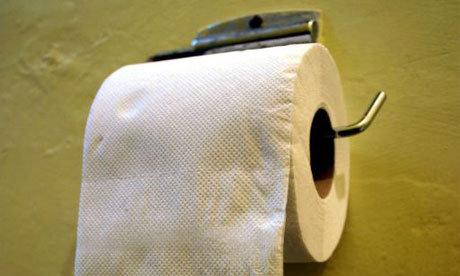
This one simple way to make an impact on the environment. An important caveat, I'm pretty sure they don't mean recycled TP.
From The Guardian (UK)...
The tenderness of the delicate American buttock is causing more environmental devastation than the country's love of gas-guzzling cars, fast food or McMansions, according to green campaigners. At fault, they say, is the US public's insistence on extra-soft, quilted and multi-ply products when they use the bathroom.
"This is a product that we use for less than three seconds and the ecological consequences of manufacturing it from trees is enormous," said Allen Hershkowitz, a senior scientist at the Natural Resources Defence Council.
A campaign by Greenpeace seeks to raise consciousness among Americans about the environmental costs of their toilet habits and counter an aggressive new push by the paper industry giants to market so-called luxury brands.
More than 98% of the toilet roll sold in America comes from virgin forests, said Hershkowitz. In Europe and Latin America, up to 40% of toilet paper comes from recycled products. Greenpeace this week launched a cut-out-and-keep ecological ranking of toilet paper products.
The New York Times reported a 40% rise in sales of luxury brands of toilet paper in 2008. Paper companies are anxious to keep those percentages up, even as the recession bites. And Reuters reported that Kimberly-Clark spent $25m in its third quarter on advertising to persuade Americans against trusting their bottoms to cheaper brands.
Here's the TP Guide but you can get the full pocket size version by clicking here.
Passengers aboard an Aeroflot flight from Moscow to New York were greeted by a welcome announcement from the pilot, Alexander Cheplevsky, that was so garbled it was impossible to tell what language he was speaking. They became so scared that a group of passengers demanded to see the man at the controls to check whether or not he was drunk.
The Moscow Times, which had a reporter on board the plane, claimed that an Aeroflot representative boarded the aircraft and told the passengers it wasn't a big deal if the pilot was drunk. "Really, all he has to do is press a button and the plane flies itself," the representative allegedly said. "The worst that could happen is he'll trip over something in the cockpit."
"I don't think there's anyone in Russia who doesn't know what a drunk person looks like," a passenger, Katya Kushner, told The Moscow Times. "At first, he was looking at us like we were crazy. Then, when we wouldn't back down, he said, 'I'll sit here quietly in a corner. We have three more pilots. I won't even touch the controls, I promise'."
If that's not bad enough, check this out from The Mail (UK)...
An aircrew arrested after £250,000 ($350,000) of cocaine was discovered in baggage on a plane have been released on bail.
The 15 South African Airways employees were arrested after UK Border Agency officers found 5kg of cocaine when their flight from Johannesburg arrived at Heathrow.
The latest arrests follow a similar incident on January 21, when a 15-member crew from the same airline was arrested after cocaine and cannabis worth £310,000 ($435,000) was found on their flight.
In a study with significant implications for everyday life, two researchers from University of Chicago and Northwestern found that small groups with an odd number of members tend to work better than groups with an even number of members.
The conventional wisdom is that even numbers and even-numbered groups are better. However, in an experiment with discussion groups and in an analysis of dormitory groupings at Harvard, the researchers found that even-numbered groups resulted either in stalemate (e.g., two against two) or domination (e.g., three against one). In odd-numbered groups, disagreement often implies a swing vote (e.g., two against one), which encourages the majority to tread more carefully.
One caveat is that the odd-number effect is less powerful in groups that are more diverse, because those groups are less cohesive in the first place.
Watch what you drink in the morning, its' probably a whole lot older and filled with more chemicals than you think.
Alissa Hamilton, author of Squeezed gives a behind the scenes look at the complex packaging technology and processing that supports the supposedly “fresh” juice we drink.
In the process of pasteurizing, juice is heated and stripped of oxygen, a process called deaeration, so it doesn't oxidize. Then it's put in huge storage tanks where it can be kept for upwards of a year. It gets stripped of flavor-providing chemicals, which are volatile. When it's ready for packaging, companies such as Tropicana hire flavor companies such as Firmenich to engineer flavor packs to make it taste fresh. People think not-from-concentrate is a fresher product, but it also sits in storage for quite a long time.
Flavor packs are technically made from orange-derived substances, essence and oils. Flavor companies break down the essence and oils into individual chemicals and recombine them. I spoke to many people in the industry at Firmenich, different flavorists, and at Tropicana, and what you're getting looks nothing like the original substance. To call it natural at this point is a real stretch.
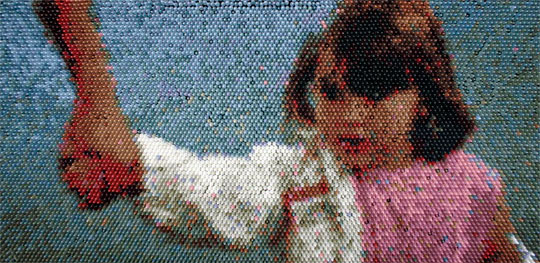
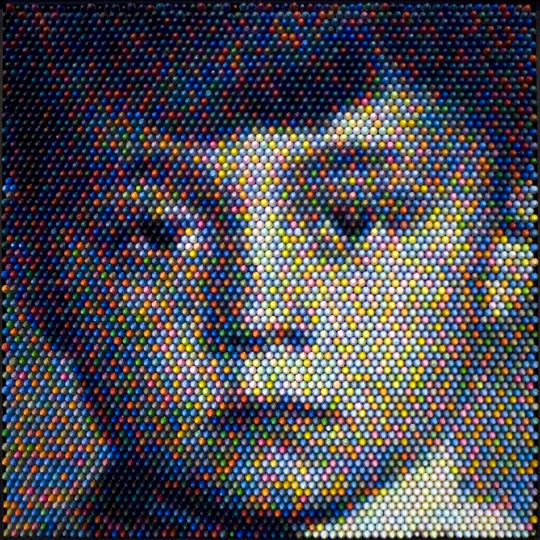
I remember how excited I was when I got a new box of 64-count Crayola crayons. The color possibilities seemed endless and they still are for artist Christian Faur.
Christian Faur is an artist based in Granville, Ohio. Looking for a new technique, he experimented with painting with wax, but he didn't feel the results were satisfactory. Then, at Christmas in 2005, his young daughter opened a box of 120 Crayola crayons he'd bought her, and everything clicked into place...
For his collection of recent work, Christian Faur assembled over one hundred thousand hand cast crayons of differing colors and shades to produce a unique pixelated expression that the artist hopes balances the qualities of both photography and sculpture.
Here are some examples of Faur's art but I highly recommend clicking through to the Telegraph slide show and to Faur's website, the artwork is quite impressive. By the way, some of the "paintings" also contain encoded messages utilizing a color coded alphabet that Faur developed.
Look's like Kellogg's is taking a beating since it dumped Michael Phelps over his infamous bong-hit picture. I always thought Kellogg's response was a bit much and also hypocritical since they didn't cut him after he got busted for a DUI.
Of course everyone doesn't feel the same way and that came through loud and clear when my niece told me that all the Michael Phelps posters in her school had been taken down after the bong incident. A bit overreactive are we?
When Kellogg announced it would not renew its endorsement contract with Olympic medalist Michael Phelps after a photo of the athelete smoking pot surfaced, it may have cost the food company its sterling reputation, reports company reputation index Vanno.
Out of the 5,600 company reputations Vanno monitors, Kellogg ranked ninth before it booted Phelps. Now it's ranked 83.
The whole Phelps incident has led to the creation of a new catch phrase. From Urban Dictionary...
"Off the box"
Meaning: "the state of being removed from a position of prominence/importance due to a foolish mistake. Related to Michael Phelps being dropped by Kellogg after a picture of him with a bong was released."Usage: "Dude, after that bonehead move you are so off the box."
Stuart Semple released 2057 pink smiley faced clouds near the Tate Modern museum in London (great museum btw if you happen to visit London). They were made of helium, biodegradable soap and vegetable dye and after 30 minutes they dissolved in the air.
I just wanted to make a piece of work that would cheer people up a bit. I've had enough of the doom and gloom in the air and I wanted to show something completely positive floating up to the sky. This was the most straight forward way I could think of to literally contribute something happy to the atmosphere. I'm hoping it might put a smile on a few people's faces as they go through their day.
...I know at times like this it's easy to make creativity a low priority but I want to show that on a very human level an artistic idea might be able to do something important even for a fleeting moment.
Local people, including children on their way to temporary schools in Mianyang, have to get across the river by the pulleys on the steel cable after the earthquake in May 2008 collapsed a bridge in Beichuan county in China's Sichuan province.
It's been almost a year since the quake it would seem like the Chinese would have fixed this problem some other way by now.
 Everyone knows of many awful things that have happened because of the global recession but at least in one area the recession has had a positive impact.